

In 2026, running a successful restaurant isn’t just about serving great food; it’s about being discovered, remembered, and chosen by customers every time. The best restaurants combine unique experiences with smart digital marketing to turn first-time diners into loyal fans.
In a world where diners Google before they walk in the door, your unique selling points (USP) aren’t just nice to have; they’re the difference between a packed house and an empty one.
We’ll break down unique selling point examples for food that actually work today.
1. Pinpoint Your USP: What Makes Your Restaurant Irresistible
A unique selling proposition (USP) is the one clear reason a customer should pick your restaurant over the one across the street. A strong USP sets your restaurant apart in a crowded market.\
Unique Value Proposition Restaurant Examples:
- Signature Dishes: In-N-Out Burger’s “secret menu” creates excitement and turns customers into insiders.
- Locally Sourced Ingredients: Sweetgreen emphasizes fresh, transparent sourcing, attracting health-conscious diners.
- Vibrant Atmosphere: Talkin’ Tacos in Miami combines trendy menu items with a high-energy space, creating a cultural moment, not just a meal.
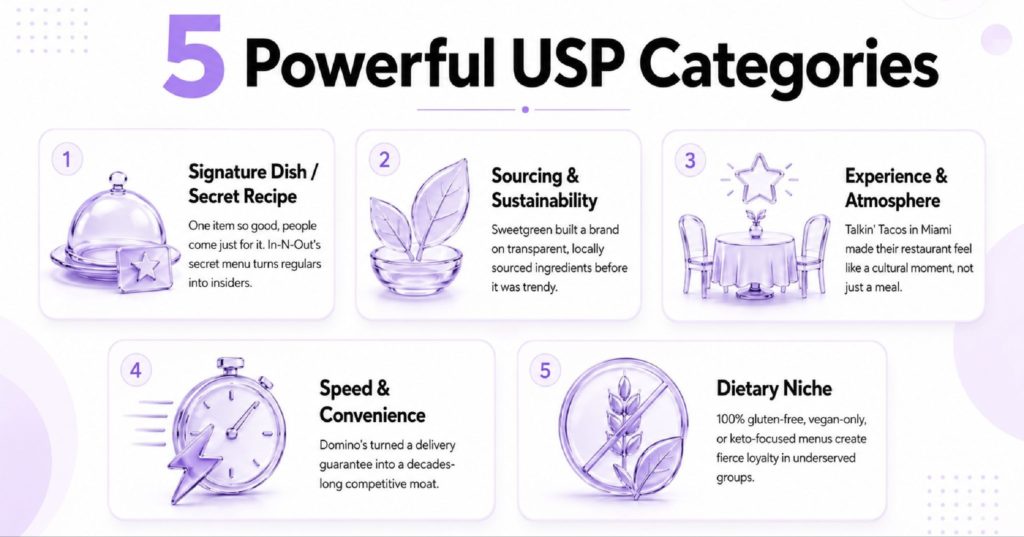
How to Find Your Own USP in 5 Steps
The best USP is already hiding in your restaurant. Here’s how to surface it:
- Know your neighbourhood
Office workers nearby? Young families? Budget-conscious students? Your menu-market fit shapes everything. A USP that resonates in Yorkville won’t land the same way in a college town.
- Run a competitor SWOT
List every restaurant within 2km. What do they do well? Where do they fall flat? The gap in their offering is often your opportunity.
- Ask your regulars
“Why do you come here instead of somewhere else?” The answer is usually your USP, already articulated, for free, by your best customers.
- Make it specific and defensible
“Great food, great service” is not a USP. “The only restaurant in [neighbourhood] with a 100% gluten-free kitchen” is.
- Check it against 2026 trends
Does your USP touch personalization, sustainability, experience, or authenticity? If yes, it’s future-proof. If not, consider how you might evolve it.
Why Your USP Matters More Than Ever Right Now
The market is massive and so is the competition. Diners are spoiled for choice, increasingly sophisticated, and making decisions in seconds online.
According to FSR Magazine’s 2026 outlook, guests today want to be recognized, understood, and surprised. They’re looking for an experience they’ll talk about. A generic restaurant can’t give them that. A restaurant with a sharp USP can.
The 2026 dining landscape is also being reshaped by technology. AI-powered personalization, delivery-first formats, and sustainability are no longer trends; they’re table stakes. Your USP needs to reflect where the world is going, not where it was.
2. Optimize Your Digital Presence
Your website is the hub of your marketing. Every social post, ad, or Google search leads back there.
Must-haves for 2026:
- Mobile-First Design: 60% of traffic is mobile; ensure menus, hours, and order buttons are clear and easy to use.
- Fast Load Times: Slow websites lose customers.
- Accessible Menu: Avoid PDFs; make it scannable and searchable for both customers and Google.
Google Business Profile Tips:
- Keep address, hours, and photos accurate.
- Use natural, local language in posts.
- Respond quickly to reviews to improve visibility and trust.
3. Leverage Social Media With Short-Form Video
Static images no longer capture attention. Customers want quick, engaging content they can almost taste.
2026 Trends:
- Instagram Reels & TikTok: Show preparation, plating, or fresh dishes in real time.
- Stories for Urgency: Post limited-time offers or daily specials; disappearing content encourages quick action.
- User-Generated Content & Micro-Influencers: Encourage diners to tag your restaurant; collaborate with local influencers for targeted reach.
4. Retain Customers With Email & SMS
Direct channels like email and SMS outperform social in driving repeat orders.
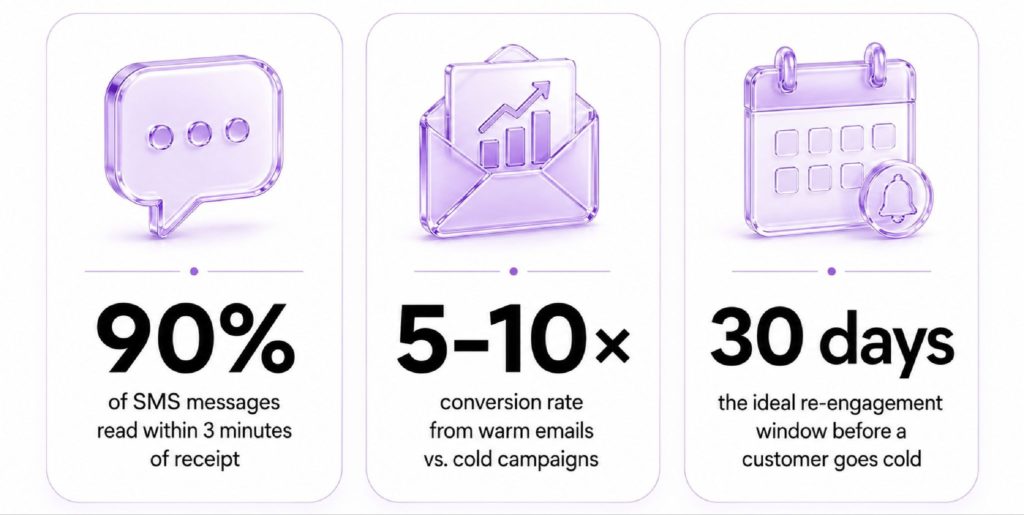
The key difference between restaurants that grow and those that plateau is whether they treat email and SMS as an afterthought or as a system. Here’s how to build that system.
Email: Nurture & Inform
Best for longer, value-driven messages. Use it to:
- Welcome new subscribers with a first-order offer
- Announce seasonal menus or limited dishes
- Share loyalty point updates and tier upgrades
- Win back customers who haven’t ordered in 30+ days
- Drive event RSVPs and private dining bookings
SMS: Urgency & Action
Best for short, time-sensitive nudges. Use it to:
- Flash deals on slow weekday afternoons
- Notify customers when a reward is ready to redeem
- Alert loyalty members to expiring points
- Remind guests about upcoming events the day before
- Send a “we miss you” with a comeback offer
What a well-timed SMS loyalty message actually looks like:
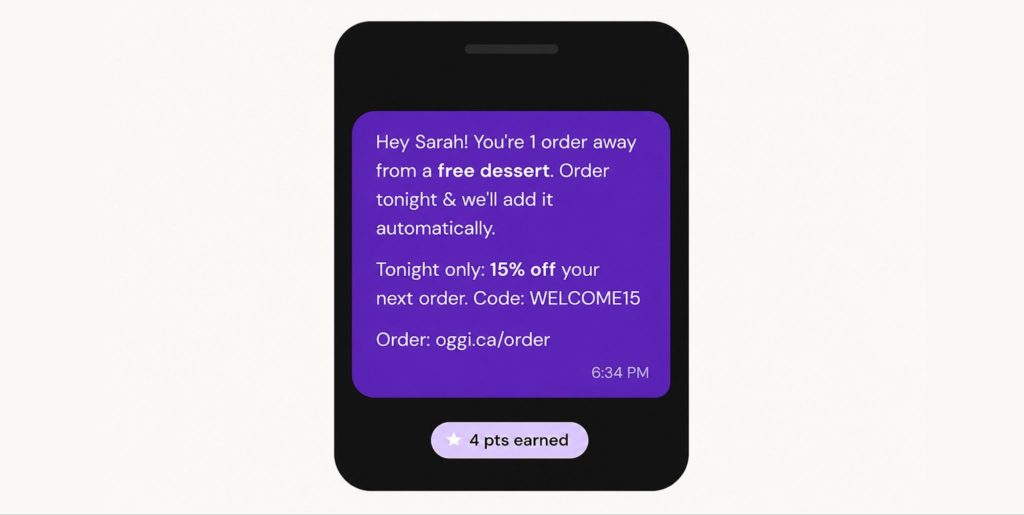
How to maximize results:
- Segment your audience (first-time vs regulars).
- Automate welcome, loyalty, and re-engagement campaigns.
- Reward top customers with exclusive perks, early access, or priority seating.
Pro tip: Start with just two automations: a welcome message with a small incentive for new subscribers, and a re-engagement offer for anyone who hasn’t ordered in 30 days. These run in the background and quietly drive revenue without any manual effort on your end.
5. Paid Ads & Retargeting
Most restaurants run ads hoping for visibility. The highest-performing ones run ads designed for conversions; every dollar spent should be traceable to an order, not just an impression. Here’s how to think about each channel.
Meta Ads: Stay Top of Mind
Set a geo-fence of 3-5 miles around your restaurant so you only reach people close enough actually to order or walk in. No wasted spend on audiences who’ll never convert.
What performs best: a single bestselling dish with a clear photo, a limited-time offer with a deadline, or a simple “open now” reminder. No complicated funnels needed.
Google Search: Capture Intent
These are people actively searching for somewhere to eat right now. Targeting queries like “best sushi near me” or “pizza delivery open now” means you’re showing up at the exact moment someone is ready to decide.
Keep ad copy simple and match it to what’s on your menu. Send clicks straight to an ordering page, not your homepage.
Retargeting is your highest-ROI ad spend, and the one most restaurants skip. Most visitors won’t order on their first visit to your site; that’s normal. Retargeting lets you follow up with those people as they browse Instagram or other sites, showing them the dish they already looked at. Because the audience is already warm, even a few dollars a day can generate meaningful returns. Start here before scaling any broader campaigns.
Where to start: Install the Meta Pixel on your website, set up a retargeting audience of past visitors, and run one ad featuring your most photogenic dish or a current promo. Set a daily budget of $5-$10 and run it for two weeks before evaluating. Simple, measurable, and often the fastest way to see a return on paid spend.
6. Menu Engineering & Descriptions That Sell
Your menu can drive orders and revenue without extra traffic.
2026 Best Practices:
- Surface your top 2-3 bestsellers at the top of each category, not buried halfway down the scroll
- Use “Most popular” or “Chef’s pick” badges to guide first-time visitors who don’t know where to start
- Keep descriptions under 25 words; mobile menus punish long copy
- Avoid PDFs; they’re unreadable on mobile and invisible to Google
- Recommend add-ons (drinks, sides, desserts) before checkout; even one prompted upgrade lifts average order value meaningfully across hundreds of orders
7. Track, Measure, and Iterate
Marketing isn’t a one-time project. The restaurants that grow consistently treat it as a continuous loop: every campaign produces data, and that data drives the next decision. Here’s what that loop looks like in practice:
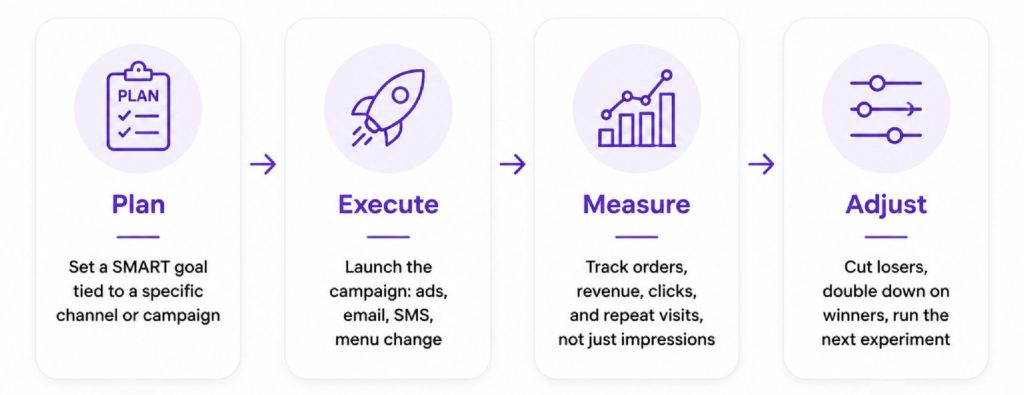
Most restaurant owners track the wrong things. Getting 500 impressions on an Instagram Reel feels good, but if it didn’t generate a single order, it didn’t move the business. These are the metrics that actually matter:
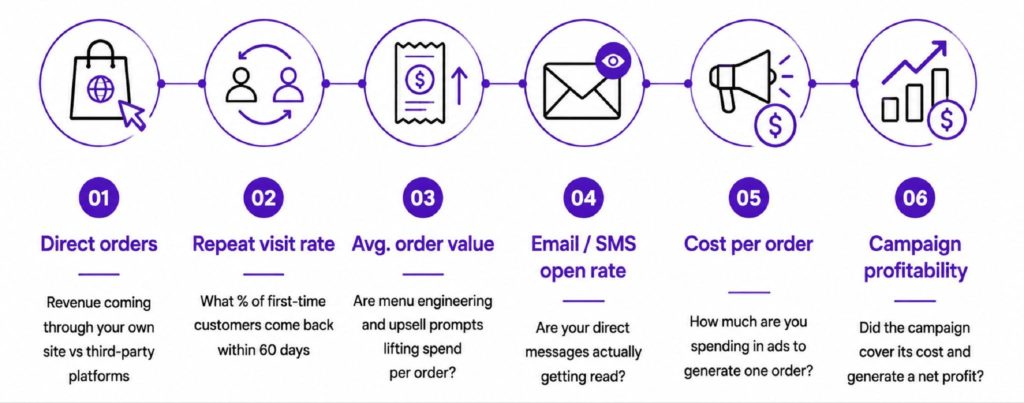
Beyond the numbers, look for patterns across channels and time. Which menu items appear most often in first orders? Which days or times consistently convert better? Which channel drove your most loyal regulars? These patterns are where your most valuable marketing insights live.
A campaign that drives traffic but loses money isn’t a success. Track profitability, not just clicks or impressions, and cut campaigns that don’t pay for themselves, even if the vanity metrics look great.
The 2026 Usp Trends Shaping The Industry
The most compelling USPs in 2026 tap into what diners actually care about right now. Here’s what’s cutting through the noise:
Hyper-Personalization
Menus that adapt to past orders and dietary goals. Diners expect to be known, not just served.
Radical Transparency
Farm-to-table isn’t enough. Diners want blockchain-level traceability on what’s on their plate.
Dining as an Event
Immersive rooms, chef interactions, surprise menus. The Global Private Dining market is headed to $87B by 2035.
Human over AI
As AI-generated content floods feeds, real stories, real chefs, real hospitality stand out more than ever.