
There is a surprisingly common gap in digital marketing.
A business invests in a new website or Shopify store. It pays for SEO, Google Ads, or paid social. Mailchimp, Klaviyo, or another email platform is connected somewhere along the way.
Then… almost nothing happens with it.
Maybe there is an occasional newsletter or Black Friday promotion. But when someone subscribes, abandons a cart, makes a first purchase, downloads a resource, or becomes due for a reorder, there is no meaningful follow-up.
This is where email marketing services should do more than simply help a business send newsletters. The real opportunity is to turn the platform you already pay for into a system of automated, segmented communication tied to customer behaviour.
If your business is already paying to acquire traffic, leaving that system inactive becomes especially expensive. You are paying to bring people to your website but doing very little to continue the conversation when they don’t convert immediately.
The First Question Isn’t “Which Email Platform Should We Use?”

For many businesses, the answer is: the one you already have.
Before migrating from Mailchimp to Klaviyo, upgrading your plan, adding another CRM, or buying another marketing tool, look at what is already connected to your business.
Ask:
- Are new subscribers automatically welcomed and moved towards a useful next step?
- Does anything happen when an identified shopper leaves products in their cart?
- Do first-time customers receive relevant post-purchase communication?
- Are previous customers reminded when they may be ready to reorder?
- Are B2B leads nurtured differently based on their interests or actions?
- Are contacts segmented according to behaviour, purchase history, or lifecycle stage?
- Can you tell which automated emails generate leads, orders, or revenue?
If the answer to most of these questions is no, another platform probably isn’t the first thing you need.
You need to activate the one you have.
A Campaign and an Automated Flow are not the Same Thing
This distinction is where many email programs break down.
- A campaign is something your team chooses to send at a particular time: a newsletter, promotion, product launch, company update, or seasonal offer.
- An automated flow responds to something the customer does.
Someone subscribes. Someone abandons checkout. Someone makes a first purchase. A lead downloads a guide. A previous customer hasn’t ordered in 90 days.
That behaviour triggers the appropriate sequence without somebody on your team having to remember to send it. Depending on the strategy, this may be a single triggered message, a multi-email automation, or an email drip campaign that guides the contact through several steps over time.
That makes automation much more than a productivity feature. It changes when your marketing reaches someone.
Current Klaviyo benchmark data illustrates the difference. Its 2026 benchmarks, based on more than 183,000 customers, found that flows generated nearly 41% of email revenue despite representing only 5.3% of email sends. Average click rates were also substantially higher for flows than regular campaigns.
The lesson isn’t that newsletters and promotional campaigns should disappear. They serve a different purpose.
It’s that a business sending campaigns without building lifecycle automation is using only part of its email marketing system.
If You’re Starting From Zero, Don’t Build 15 Flows
This is another common mistake.
Once businesses discover automation, there is a temptation to map every imaginable customer journey at once.
Don’t.
Start with the moments closest to revenue or a meaningful sales action.
For an eCommerce business, the first priorities will usually look something like this:
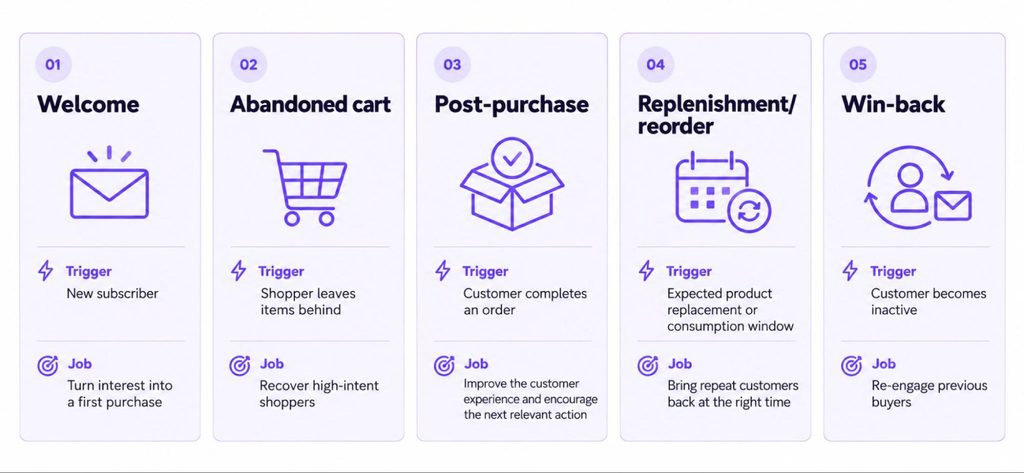
A B2B company needs a different map. There may be no cart to recover. Instead, a high-value starting point could be a lead-nurture sequence triggered after someone downloads a guide, submits an enquiry, attends a webinar, or shows interest in a particular service.
The platform can be the same. The automation strategy shouldn’t be.
Where eCommerce Email Marketing Should Start: The First Two Flows We’d Look At
If an eCommerce account has little or no automation, an effective eCommerce email marketing strategy doesn’t need to start with dozens of flows. Two opportunities deserve immediate attention.
1. Welcome Flow
Someone has just voluntarily entered your email ecosystem.
A person who sees a cold advertisement for the first time is considerably different from that.
A useful welcome series shouldn’t simply say “Thanks for subscribing” and immediately start sending generic promotions.
Depending on the brand, the sequence could introduce the value proposition, answer a major buying objection, show a bestselling category, explain what makes the product different, provide social proof, or move the subscriber towards a first purchase.
The sequence should answer a simple question:
What does a new subscriber need to understand before they feel comfortable taking the next step?
2. Abandoned Cart Flow
This audience has gone much further.
They didn’t merely visit the website. They showed interest in a specific product and added it to their cart.
That makes an abandoned cart email flow one of the clearest opportunities for behaviour-triggered communication in eCommerce.
Klaviyo’s current flow benchmarks break abandoned-cart performance down by business revenue and average order value, which is a much better way to evaluate performance than applying one universal benchmark to every store.
A cart sequence can remind the shopper what they left, answer likely objections, reinforce delivery or returns information where relevant, introduce trust signals, and make it easy to resume checkout.
And importantly, cart recovery does not automatically mean offering a discount.
If customers are abandoning because shipping is unclear, sizing information is weak, trust is missing, or checkout creates friction, constantly giving them 10% off can mask the real conversion problem.
Email data can help identify that problem.
What Happens to All the Traffic You’re Already Buying?
This is where email activation becomes bigger than email itself.
Imagine you are paying for Google Ads.
A potential customer clicks an ad, visits the website, browses two products, and leaves.
Your ad did its job: it generated the visit.
But expecting every paid visitor to purchase on that first session is unrealistic.
The same applies to SEO. Ranking for a valuable query gets a prospective customer through the door; it doesn’t guarantee that they are ready to buy, book, or request a quote immediately.
Email gives businesses a way to continue relevant communication with people who have provided appropriate consent and identified themselves.
That means email shouldn’t sit in a separate marketing silo.
SEO and ads acquire attention. Your website converts part of it. Email can help nurture the portion that isn’t ready yet and retain the customers you already acquired.
If you’re spending heavily on acquisition while your email automation sits empty, it is worth examining the economics of the whole funnel before simply increasing your ad budget.
Already paying for traffic but not following up with the people it brings in?
Digilite’s email marketing services can help identify what your existing Mailchimp, Klaviyo, or email setup is missing. We’ll review the platform, existing automations, segmentation, and customer journey to identify which flows should be activated first.
Book your email platform audit
Repeat-Purchase Businesses Have Another Opportunity
Some businesses have an advantage that should make email automation particularly interesting: they know approximately when customers will need something again.
Think consumable products, beauty and personal care, pet supplies, replacement parts, subscriptions, supplies purchased by B2B customers, or products with a predictable replacement cycle.
If customers typically reorder around a particular interval, a replenishment flow can reach them around that buying window.
That is very different from sending the entire database:
“Time to order again!”
The timing can be connected to the customer’s actual purchase history.
For B2B businesses, the same principle can apply to distributors and suppliers. Instead of relying entirely on a salesperson to remember every possible reorder opportunity, email automation can support the process with timely reminders, product information, and relevant follow-up.
Salespeople can then spend more time on conversations that actually require a person.
Segmentation is What Turns An Installed Tool Into A Marketing System
Installing Klaviyo or Mailchimp doesn’t mean you have an email strategy.
Uploading one giant contact list doesn’t either.
The useful part starts when the business can distinguish between people who need different messages.
For example, an eCommerce business might separate:
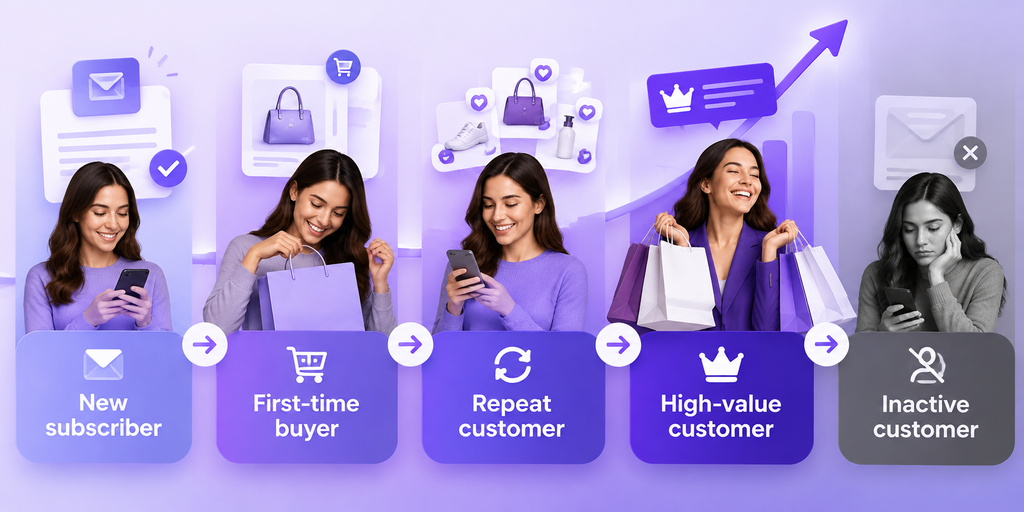
A B2B business could instead have:
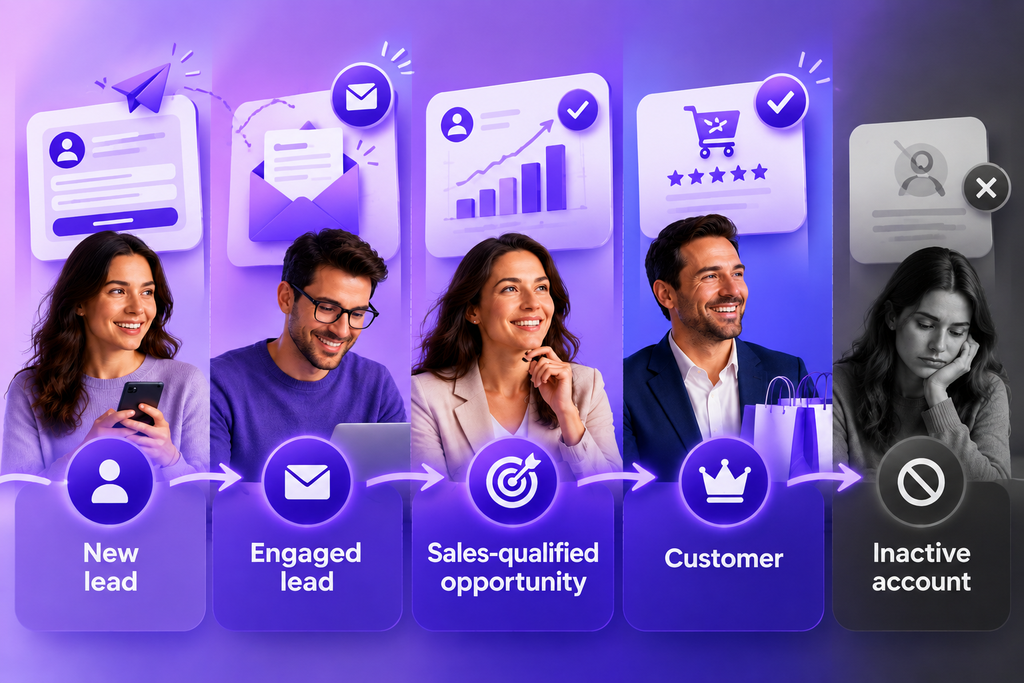
Then behaviour adds another layer.
What did the person browse? What did they buy? What did they click? Which category interests them? How recently did they interact? What should happen next?
Good segmentation prevents a common email marketing problem: sending technically correct emails to completely inappropriate audiences.
Don’t Automate Bad Email
Building the trigger is only half the work.
The email itself still has to earn attention and make the next step obvious.
At Digilite, that means looking beyond whether an automation technically “works.” Email strategy also involves subject lines, copy, hierarchy, mobile presentation, brand consistency, imagery, calls to action, segmentation, testing, and ongoing performance analysis. You can see these principles in practice in our email marketing case study, where the strategy included subject-line optimization, personalization, stronger visuals, calls to action, and interactive elements.
For example, a conversion-focused email should normally make the main action easy to understand quickly. It shouldn’t force someone to dig through several paragraphs to discover why the message was sent.
Personalization should also go beyond dropping Hi [First Name] into the first line.
Useful personalization can come from context:
- The product someone viewed
- The category they purchased
- Their stage in the customer lifecycle
- The content they requested
- Their previous interactions
- The likely next action
That is what makes an email feel relevant rather than automated.
Open Rate Alone Doesn’t Tell You Whether Email is Working

Open rates can help diagnose performance, but they shouldn’t be the only number in the monthly report.
What matters depends on the purpose of the flow.
For eCommerce, useful measures may include click rate, placed-order rate, revenue per recipient, flow-attributed revenue, unsubscribe rate and repeat purchase behaviour.
For B2B, the goal may instead be a consultation, qualified enquiry, return website visit, resource download, sales response or movement into the next stage of the pipeline.
The question should always be:
Did this email move the right person towards the action the business actually needs?
Then use the data to improve the next version.
Test the subject line. Change the offer. Simplify the CTA. Adjust timing. Review the segment. Test a different content angle.
Automation doesn’t mean “set it and forget it.”
It means build it once, let it operate continuously, and improve it using real behaviour.
Before Turning Anything on, Check the Plumbing
A beautiful automation is useless if the data feeding it is wrong.
Before activating flows, we would want to know whether:
- The website or eCommerce integration is passing the required events
- Products and purchase information are syncing correctly
- Signup forms feed the right lists or segments
- Suppression and unsubscribe rules work correctly
- Duplicate or conflicting automations already exist
- Sending-domain authentication is configured appropriately
- Contacts have been collected and can be contacted in accordance with applicable requirements
- Test purchases, abandoned carts, and form submissions actually trigger the intended journey
For Canadian businesses, this also means considering Canada’s Anti-Spam Legislation (CASL). Commercial electronic messages are subject to requirements around consent, sender identification, and unsubscribe mechanisms.
Compliance shouldn’t be something added after the flow is designed.
It belongs in the setup.
A Quick Email Activation Audit
If your business already has Mailchimp, Klaviyo, or another email platform, open it and answer these questions:
1. How many automated flows are currently live?
Not drafted. Not planned. Actually live.
2. What percentage of new subscribers enter a welcome sequence?
If the answer is zero, start there.
3. What happens after an identified shopper abandons a cart?
If the answer is nothing, you have found another priority.
4. What happens after someone buys?
A transactional receipt isn’t a retention strategy.
5. Do repeat customers receive communication based on what or when they purchased?
If not, investigate whether your purchase cycle makes replenishment or cross-sell automation useful.
6. What happens to a B2B lead after the initial form submission?
If the answer is “sales will follow up,” determine what happens when sales doesn’t reach them immediately, or the prospect isn’t ready yet.
7. Can you connect email activity to meaningful business outcomes?
If your dashboard stops at opens and clicks, improve the measurement setup.
If those seven questions expose several gaps, you probably don’t need another email tool yet.
You need a better use of the one you’re already paying for.
Want to check your whole email setup?
What Digilite Looks At When Activating An Existing Email Account
Working with an email marketing agency doesn’t have to mean replacing the platform you already use. Digilite’s email marketing services can start with the system you already have.
Instead of assuming the answer is a migration or a larger software subscription, we can first review the current setup: platform, integrations, lists, segments, existing campaigns, automations, templates, tracking, and obvious lifecycle gaps.
From there, priorities should follow the business model.
For an eCommerce store, that may mean getting welcome and cart-recovery flows working before adding post-purchase, replenishment, and win-back sequences.
For a B2B company, it may mean building segmented lead nurturing around the content, services, and buying signals that matter to its sales process.
And once the foundation works, ongoing email marketing services can extend into campaign planning, newsletter and promotional campaigns, segmentation, A/B testing, design, reporting, and optimization.
The goal isn’t to send more email.
It’s to make the email you send more relevant to what the customer is doing and more useful to the business.
Before Buying Another Marketing Tool, Find Out What This One Should Be Doing
If you’re already paying for Mailchimp, Klaviyo, or another email platform but aren’t sure whether it’s contributing to leads, sales, or retention, don’t start by buying another tool.
Start by finding out what the one you already have should be doing.
Book your email platform audit with Digilite.
We’ll review:
- What’s currently installed and connected
- Which automations and customer journeys are already live
- Which important flows are missing
- Where segmentation or tracking needs attention
- Which opportunities should be activated first
You’ll come away with a prioritized email activation plan showing what to fix, build, and optimize next. Book Your Email Platform Audit.
FAQs
1. What is email marketing automation?
Email marketing automation uses predefined triggers to send relevant emails automatically based on actions such as subscribing, abandoning a cart, making a purchase, or becoming inactive.
2. What eCommerce email marketing automations should a business have?
A good starting point is a welcome flow, abandoned cart flow, and post-purchase flow. Replenishment and win-back flows can then be added depending on the products and customer buying cycle.
3. What is the difference between an email campaign and an automated flow?
A campaign is manually scheduled and sent to a selected audience. An automated flow is triggered by a customer action or lifecycle event and continues running without someone manually sending each email.
4. Do I need to switch from Mailchimp or Klaviyo to improve my email marketing?
Not necessarily. If your current platform already supports the segmentation, tracking, and automation you need, activating and optimizing the existing setup may be more useful than switching platforms.
5. Can email marketing work with SEO and paid ads?
Yes. SEO and paid advertising can bring people to your website, while email can help nurture appropriately consented prospects who are not ready to convert immediately and re-engage existing customers.