
A few years ago, running Google Ads was mostly about choosing the right keywords, setting a daily budget, and waiting for clicks.
Today, it’s more complex.
Google Ads now includes AI-powered campaign types, automated bidding, Performance Max, AI Max for Search, consent-based measurement, visual assets, and ads appearing in newer AI-driven search experiences.
For Canadian businesses, this means your budget has to do more than “get traffic.” It needs to attract high-intent users, protect against wasted clicks, track conversions properly, and work with a landing page that can actually turn visitors into leads or sales.
So, what is the Google Ads cost per click in Canada? The honest answer: it depends on your industry, location, competition, campaign setup, landing page quality, and conversion tracking.
This guide breaks down how Google Ads budgeting works, what affects your costs, which 2026 trends matter, and how businesses can reduce wasted spend while improving results.
How Does Google Ads Budgeting Work in 2026?
Managing a budget isn’t just about spending; it’s about machine learning efficiency.
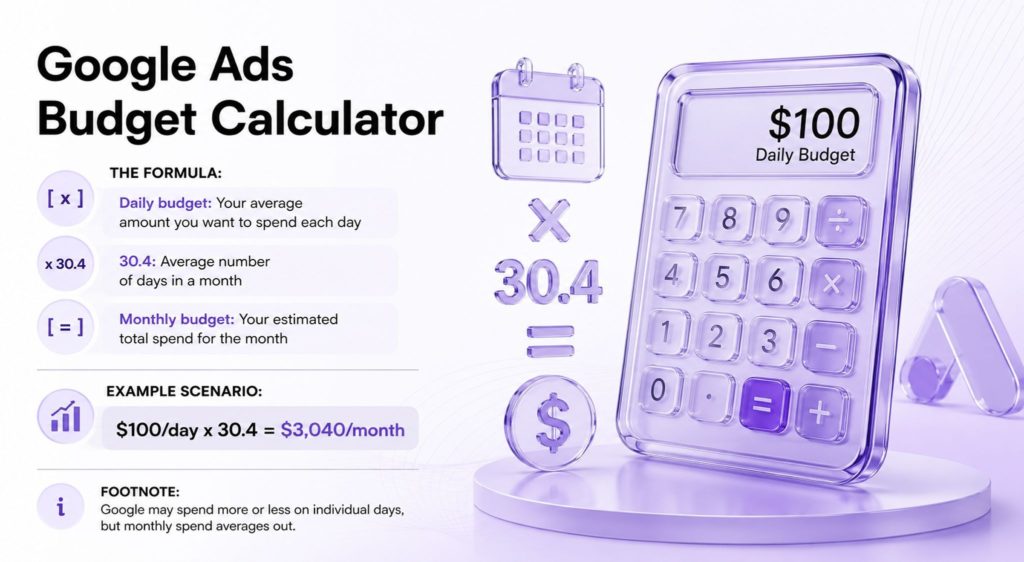
- The 30.4 Rule: Google still calculates your monthly limit by multiplying your daily budget by $30.4$. On high-intent days, Google may spend up to 2x your daily budget.
- The AI Premium: In 2026, Google’s “AI Mode” in Search is where 75% of consumers are making decisions. Campaigns using the full AI feature suite are seeing a 7% lift in conversions.
Pro Tip: Spend 70% of your budget on proven campaigns, 20% on scaling, and 10% on testing new AI-driven formats. While the 70/20/10 rule is a strong benchmark for stability, it is important to remember that every business is unique and this distribution may need to be adjusted based on your specific industry data and campaign goals to ensure success.
2026 Benchmarks: Average Costs in Canada
In Canada, the average cost for Google Ads continues to rise, reflecting trends seen in the US and other Tier 1 markets like Australia. Businesses typically see an average CPM of $13.40 and a CPC of $1.75, with CPMs generally ranging from $11 to $16. This increase, about 12% year-over-year, is largely driven by heightened competition and a strong retail presence in major Canadian markets.
Cost also varies significantly by industry:
| Industry | Avg. CPC (CAD) | Competition Level | Notes / Regional Context |
| Legal Services | $8 – $45+ | Ultra High | Personal injury tops out highest in Toronto & Vancouver |
| Finance & Insurance | $15 – $50+ | Very High | Highest in major urban markets |
| Home Services (HVAC, plumbing, contractors) | $6 – $25 | High | Costs vary with market saturation |
| Dental | $4 – $18 | High | Higher in Toronto, Vancouver, Calgary |
| Real Estate – Residential | $3 – $12 | High | Residential CPC lower than commercial |
| Real Estate – Commercial | $15 – $40 | Very High | Higher competition for commercial leads |
| B2B SaaS | $4 – $30+ | High | Depends on product category competitiveness |
| E-commerce | $0.50 – $8+ | Moderate | Highly variable by product |
| Consumer Services | $3.50 – $6.50 | High | Local service industries |
| Restaurants & Hospitality | $1 – $6 | Moderate | Seasonal variation can affect CPC |
| Travel & Hospitality | $1 – $2 | Moderate | Atlantic Canadian CPCs 20–40% below Toronto/Vancouver |
What’s New with Google Ads in 2026?
Google Ads has moved beyond simple keywords. Success now relies on AI-driven automation, high-quality creative assets, and precise data.
1. The Rise of AI Max for Search
Google’s AI Max now powers Search campaigns, using Gemini-driven intelligence to expand reach and customize ad text in real-time.
- The Impact: Your ads can find customers beyond your keyword list, but only if your website and conversion tracking are perfectly optimized for the AI to “read.” But remember, while AI tools can find customers beyond your keyword list, they must be used with caution, as they can easily spend budget on irrelevant traffic; therefore, if you use these features, daily account checks are essential to ensure the automation stays aligned with your goals.
2. Performance Max (PMAX) Transparency
The “black box” is opening. Google now provides detailed reporting on channel performance (YouTube vs. Search) and specific search term insights.
- The Impact: You can finally see exactly which channels are driving your ROI and which are just burning budget.
3. Ads in AI Overviews
Paid visibility is now integrated into AI Overviews and Conversational Search.
- The Impact: Search is becoming more visual and intent-based. Your landing pages must directly answer complex customer questions to stay relevant.
4. Precision Measurement
With stricter privacy rules, Consent Mode and Enhanced Conversions are now mandatory for accurate reporting.
- The Impact: If your tracking is broken, your ads look expensive. Clean data in GA4 is the only way to prove your actual Cost Per Acquisition (CAC).
Key Metrics to Estimate Google Ads Costs
Google Ads includes several ad formats. Google Ads today combines traditional metrics with AI-driven optimization. Here’s what matters most:
Key Metrics:
- Cost Per Click (CPC): What you pay per click. Influenced by bids, competition, ad relevance, and conversion signals. AI campaigns dynamically adjust CPC to maximize conversions.
- Cost Per 1,000 Impressions (CPM): Mainly for Display & YouTube. AI-driven campaigns mix CPC/CPM to get cost-efficient results.
- Click-Through Rate (CTR): Clicks ÷ impressions. Higher CTR signals relevance, improves AI learning, and lowers costs.
- Cost Per Acquisition (CPA): Cost to acquire a lead, sale, or booking. Using enhanced or offline conversion tracking improves CPA efficiency.
- Quality Score: 1-10 scale based on ad relevance, landing page quality, and expected CTR. Higher scores reduce bid costs, but in 2026, AI factors predicted conversions too.
Why it matters for your budget:
- Lower CPC & CPA: Better tracking and first-party data help AI spend efficiently.
- High CTR: Boosts relevance signals and improves automated bidding.
- Strong Quality Score: Works with AI to lower ad costs and increase placements.
Pro Tip: Feed Google’s AI with enhanced conversions, offline conversion data, and audience signals to reduce wasted clicks and focus on high-intent traffic.
Factors Affecting the Cost of Google Ads
Google Ads costs continue to evolve in 2026, influenced by AI-powered campaigns, automation, and dynamic bidding. Understanding the key factors helps Canadian businesses optimize spend while improving conversions.
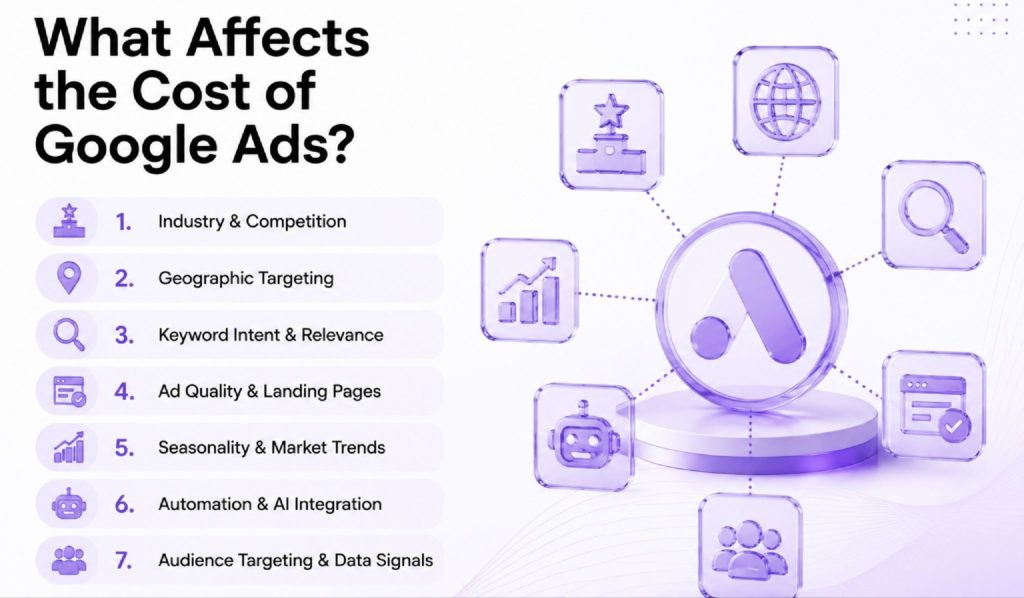
1. Industry & Competition
High-demand sectors like legal services, finance, insurance, and commercial real estate have the highest CPCs, especially in major urban markets like Toronto and Vancouver. Lower-competition industries, such as local consumer services or regional ecommerce, generally have more affordable CPCs.
2. Geographic Targeting
Costs vary significantly by region. Metro areas with dense competition drive up CPCs, while smaller cities or Atlantic Canada typically see 20-40% lower costs. Precise location targeting ensures budget is spent efficiently on audiences most likely to convert.
3. Keyword Intent & Relevance
High-intent keywords cost more but deliver better ROI. Keywords aligned with strong search intent, paired with tight negative keyword lists, reduce wasted spend and improve campaign performance.
4. Ad Quality & Landing Pages
Google’s AI evaluates ad relevance, CTR, and landing page experience. High-quality ads combined with dedicated, fast-loading, mobile-optimized landing pages reduce CPC and CPA while boosting conversions.
5. Seasonality & Market Trends
Expect cost fluctuations during peak seasons like holiday shopping, tax season, tourism peaks, and regional events. AI campaigns adjust dynamically, but proactive budget planning ensures campaigns remain competitive during high-demand periods.
6. Automation & AI Integration
Performance Max, AI Max for Search, and automated bidding optimize delivery based on real-time conversion signals. Campaigns with clean first-party data, enhanced conversions, and accurate offline conversion tracking see lower effective costs and higher ROI.
7. Audience Targeting & Data Signals:
Adding audience signals – In-Market, Custom Intent, Customer Match, or remarketing lists – improves conversion efficiency. Better targeting allows AI to bid more aggressively on high-value users without increasing overall spend.
Pro Tip: In 2026, cost efficiency isn’t just about lower bids; it’s about giving AI the right signals, maintaining high-quality creative, and targeting the right audience at the right time.
Setting a Google Ads Budget
For a Google Ads campaign to be effective, a reasonable budget must be set. The following advice is for Canadian companies:
- Daily Budget: Start with a daily budget that reflects your overall monthly spend. Google dynamically adjusts daily spending on high-traffic days, but monthly totals stay aligned. This flexibility helps AI bidding perform efficiently.
- High-Intent Keywords: Invest in keywords with the best conversion rates, even if CPCs are higher. Strong conversion signals help AI campaigns like Performance Max or AI Max optimize spend for qualified leads.
- Bid Adjustments: Adjust bids for location, device type, time of day, and audience signals. AI campaigns respond better when you guide the system toward high-quality traffic.
- Regional & Seasonal Planning: CPCs vary by city; Toronto and Vancouver often cost 20-40% more than Atlantic Canada. Plan budgets for seasonal spikes like holiday shopping, tax season, and tourism peaks.
- Data & Learning: Allow 60-90 days for AI campaigns to gather enough clicks and conversions. Adequate budget ensures the algorithm learns effectively and delivers optimized results.
How to Reduce PPC Costs
Follow these steps to reduce PPC costs:
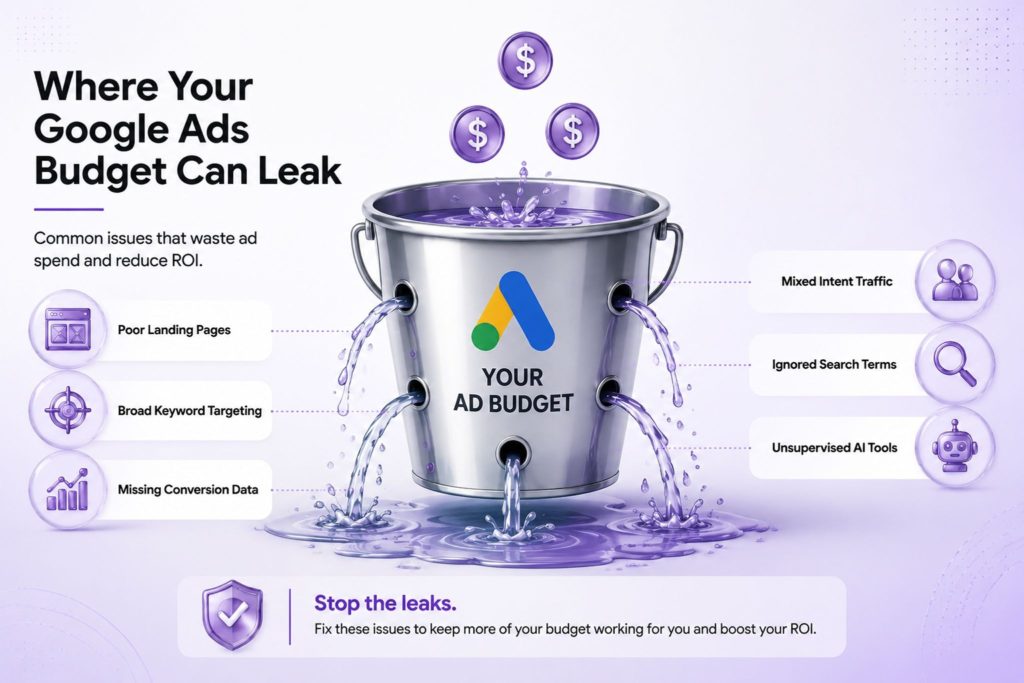
1. Improve your landing page before increasing spend
If people click but leave quickly, your ads are not the only problem. The page may need clearer headlines, stronger service details, trust signals, pricing guidance, FAQs, reviews, or a simpler form.
2. Use negative keywords and placement exclusions
Negative keywords help prevent your ads from showing for irrelevant searches. Placement exclusions help reduce wasted spend in Display and Performance Max campaigns.
3. Track real conversions, not just clicks
Form submissions, phone calls, purchases, booked appointments, quote requests, and qualified leads should be tracked properly. Without conversion tracking, Google’s automated bidding does not have the right signals.
4. Separate high-intent and low-intent traffic
Someone searching “emergency plumber near me” is not the same as someone searching “how plumbing works.” Both may be useful, but they should not always share the same budget or bidding strategy.
5. Review search terms regularly
Search term reports show what people actually typed before clicking. This is where you can find wasted spend, new keyword ideas, and better ad copy angles.
6. Use AI tools carefully
AI Max, Performance Max, and automated bidding can improve performance, but they still need human strategy. Automation works better when the account has accurate conversion data, clean assets, strong landing pages, and clear goals.
Digilite Results: What This Looks Like in Practice
The strategies above aren’t theoretical. Here’s what they produced for two of our Canadian clients:
From Budget Leakage to 128% Revenue Growth
Before partnering with Digilite, our industrial client’s Google Ads campaigns were suffering from significant budget leakage; money was being spent on irrelevant clicks, low-quality traffic, and unproductive placements. We implemented an efficiency-first strategy focused on:
- Blocking 20,000+ low-quality sites and apps
- Setting up advanced conversion tracking
- Launching a Search + Performance Max ecosystem to capture high-intent buyers
Results after 90 days:
- +128% Sales Revenue
- +100% Phone Leads
- +29% Store Visits
- −33% Cost Per Customer
Cracking a Restricted Industry with Smart Account Structure
Our mortgage client faced a double challenge: Google restricts many optimization features for Finance-sector advertisers, and their website was lean on content, making it hard to convert visitors. Our approach:
- Ran test ads first to diagnose the problem: 80% bounce rate, avg. session under 30 seconds
- Revamped website copy; average session jumped to 60+ seconds immediately
- Consolidated from fragmented per-service campaigns into one master campaign with multiple ad groups
- Progressed through Max Clicks → Max Conversions → Target CPA as volume grew
- Added ad extensions to dominate search result real estate
This project reinforced a principle we apply to every account: paid marketing can’t save a website that doesn’t convert on its own. Always have a well-optimized site before launching campaigns.
- 56.6% Cost Per Conversion
- 12% CTR increase
Pro tip from our case studies: Install Google Tag Manager and Google Analytics 4 before launching any paid campaign. Without accurate tracking, you’re flying blind, and you’ll likely optimize toward the wrong metrics.
Account Management Effectiveness in 2026
To maximize results and control ad spend in 2026, Canadian businesses need a combination of structured account management and smart AI-informed strategy:
- Maintain a Clean Account Structure: Keep campaigns, ad groups, and keywords well-organized. Group high-intent and branded terms separately for better AI optimization.
- Monitor & Adjust Performance Frequently: AI campaigns learn from conversion data — regular performance reviews and tweaks ensure the algorithm is targeting the most profitable traffic.
- Update Keywords & Negative Lists Continuously: Competition evolves quickly. Layered negative keywords and refreshed high-intent keywords prevent wasted spend and improve ROI.
- Audit Campaigns Regularly: Evaluate metrics like CPC, CPA, CTR, and conversion quality to identify inefficiencies and adjust bids, budgets, or targeting.
- Leverage AI & First-Party Data: Feed enhanced conversions, offline conversions, and audience signals into Google’s AI to improve automated bidding and reduce cost-per-conversion.
The cost of Google Ads in Canada continues to vary by industry, region, season, and campaign type. With disciplined account management and modern AI strategies, you can reduce wasted spend and get the most value from every dollar.
Pro Tip: Partnering with a skilled PPC team ensures your campaigns are structured, optimized, and adaptive to the ever-evolving 2026 landscape.