

A prospective customer used to open Google, search for a service or product, visit a few websites, and compare their options.
Now, that same customer might ask AI engines:
“Which companies in Toronto can help with SEO for a B2B service business?”
Or ask Perplexity:
“How do I choose the right eCommerce development agency for my business?”
Or use Google’s AI features to compare several options without working through ten separate search results.
That creates a new question for businesses already investing in SEO:
When an AI tool answers the question instead of simply showing search results, does your business become part of the answer?
If you haven’t tested it yet, you may not know how visible your business really is.
A strong SEO presence gives you an important foundation, but ranking well for traditional searches does not mean your brand will appear consistently whenever ChatGPT, Perplexity, or another AI-powered search experience answers a potential customer’s question.
That is where Generative Engine Optimization, usually called GEO, enters the strategy.
Does GEO Replace SEO?
No.
In fact, treating SEO and GEO as competing strategies is one of the easiest ways to misunderstand AI search.
Google’s own 2026 guidance says traditional SEO best practices continue to matter for its generative AI search features because AI Overviews and AI Mode are built on Google’s core Search ranking and quality systems. Google also says businesses do not need special AI markup, a new type of schema, or an AI-specific text file to become eligible for those results.
OpenAI makes a similar technical point from the ChatGPT side. Public websites can appear in ChatGPT Search, and publishers that want their content to be discovered and cited should make sure they are not blocking OAI-SearchBot.
So the foundation remains familiar: your website needs to be accessible, understandable, useful, and authoritative.
What changes is the outcome you are trying to measure.
Traditional SEO services typically focus on search visibility, rankings, organic traffic, and conversions.
GEO adds another question:

That is an additional visibility layer, not a replacement for SEO. Check out how to prepare for AI-driven search.
What is Generative Engine Optimization?
Generative Engine Optimization is the work involved in improving how easily AI-powered search and answer systems can discover, understand, and use information about your business.
You may also see terms such as Answer Engine Optimization, or AEO, and AI search optimization. The terminology is still developing, and the definitions often overlap.
For a business, the label matters less than the practical goal.
If someone asks an AI system a commercial question related to what you sell, you want the information it finds about your company to be clear, accurate, relevant, and strong enough to be considered alongside competing sources.
Google itself treats optimization for its own generative AI search features as an extension of SEO rather than an entirely separate discipline.
For Digilite, GEO therefore sits alongside our existing search engine optimization services. It extends the work beyond classic rankings into AI-generated discovery, brand mentions, citations, and how your company is represented within answers.
Why Can a Business Rank On Google But Still Disappear From an AI Answer?
Because an AI-generated response is not simply a traditional search results page rewritten into paragraphs.
Google explains that AI Mode and AI Overviews can use a process called “query fan-out.” The system may run several related searches across subtopics and data sources before assembling its response.
A potential customer may ask one detailed question, but the AI system can effectively investigate several parts of that question before deciding which information to use.
That means a page ranking for one target keyword is valuable, but it is only part of the picture.
AI systems also need to clearly understand things like:
- What exactly does this company offer?
- Who is the service for?
- Where does the business operate?
- What makes its approach relevant to this particular problem?
- Are its claims clear and supported?
- Is the information consistent across its website and other sources?
For eCommerce brands, accurate product information also matters. For local businesses, Google specifically recommends keeping Business Profile information current. Structured data can help machines understand information already visible on the page, but Google explicitly says there is no special AI schema required to appear in its generative features.
In other words, adding FAQ schema to a weak page is not an AI-search strategy.
Can you Test Whether AI Engine Can Find Your Business?

Yes, but a useful test should reflect how a real customer would search.
Do not simply ask:
“What do you know about [Company Name]?”
That only tells you what the system can retrieve after you have already named the business. It does not show whether someone unfamiliar with your company would discover it.
Instead, test unbranded questions that include the service, location, industry, and buyer need. For example:
- “Which SEO agencies in Toronto have experience helping B2B SaaS companies improve organic and AI-search visibility?”
- “Which eCommerce development agencies in Toronto can rebuild a Shopify Plus store for a growing retailer without disrupting existing integrations?”
- “Which web development companies in the GTA build custom B2B customer portals for manufacturers that need ERP integration?”
- “Which Canadian agencies can connect HubSpot with an existing CRM and automate lead routing for a professional services firm?”
- “What should a Toronto law firm compare when choosing an SEO agency, and which agencies have experience in legal marketing?”
Try the same questions across ChatGPT, Perplexity, and relevant Google AI experiences.
Then look beyond whether your company appeared. Check:
- How accurately your business was described
- Which services were associated with your company
- Whether your website or another source was cited
- Which competitors appeared
- Whether outdated or incorrect information surfaced
One result is not enough to draw a conclusion. AI-generated recommendations can change between runs. A 2026 SparkToro and Gumshoe study had 600 participants run 12 prompts across ChatGPT, Claude, and Google’s AI experiences 2,961 times. For ChatGPT and Google’s AI, the same list of recommended brands appeared in fewer than 1 in 100 repeated responses.
That is why AI visibility should be checked across a defined group of commercially relevant questions and repeated over time. Look for patterns rather than treating one screenshot as a permanent ranking.
Google’s Generative AI performance reports in Search Console can also provide additional visibility into how your website appears across Google’s AI-powered search experiences.
Want to test your own AI visibility?
Download Digilite’s AI Visibility Self-Audit
What Actually Improves AI-search Visibility?
There is no switch you can flip to “turn on” GEO.
AI visibility is built by making your business easier for search engines and AI systems to access, understand, and trust.
- Make Sure AI can Access Your Content
Start with the basics.
Your important pages need to be crawlable, indexable, and technically accessible. If search engines or AI search crawlers cannot reliably reach a page, the quality of the content on it will not matter much.
Technical SEO is still the foundation.
- Make it Obvious What Your Business Does
Next, look at your website from the perspective of someone who has never heard of your company.
Can they quickly understand:
- What you offer
- Who you help
- Where you operate
- What problems you solve
- What makes your approach different
AI systems need that same clarity.
If your most important information is buried under vague phrases like “innovative solutions” or “transforming businesses,” there is less concrete information for an AI system to work with.
Clear beats clever.
- Give Search Systems Something Worth Using
Publishing more content is not automatically better.
Google increasingly emphasizes original, useful content rather than pages that simply repeat what hundreds of other websites already say.
That gives experienced businesses an advantage.
Your real project experience, implementation knowledge, comparisons, decision criteria, technical explanations, and answers to genuine customer questions can all provide signals that generic content cannot.
Instead of another article called “10 Benefits of SEO,” for example, answer the question a buyer is actually asking:
“Does my business need GEO in addition to SEO?”
That is more useful to the reader and more meaningful to a search system trying to build an answer.
- Build Credibility Beyond Your own Website
Your website is important, but it is not the only source an AI system may consider.
Your company may also be described through industry publications, directories, reviews, partner websites, interviews, case studies and other credible third-party sources.
The stronger and more consistent those signals are, the easier it becomes to understand what your business does and where it fits.
The goal is not to create mentions everywhere.
It is to build a digital presence that makes your business easy to find, easy to understand, and easy to verify.
Five Common GEO Mistakes
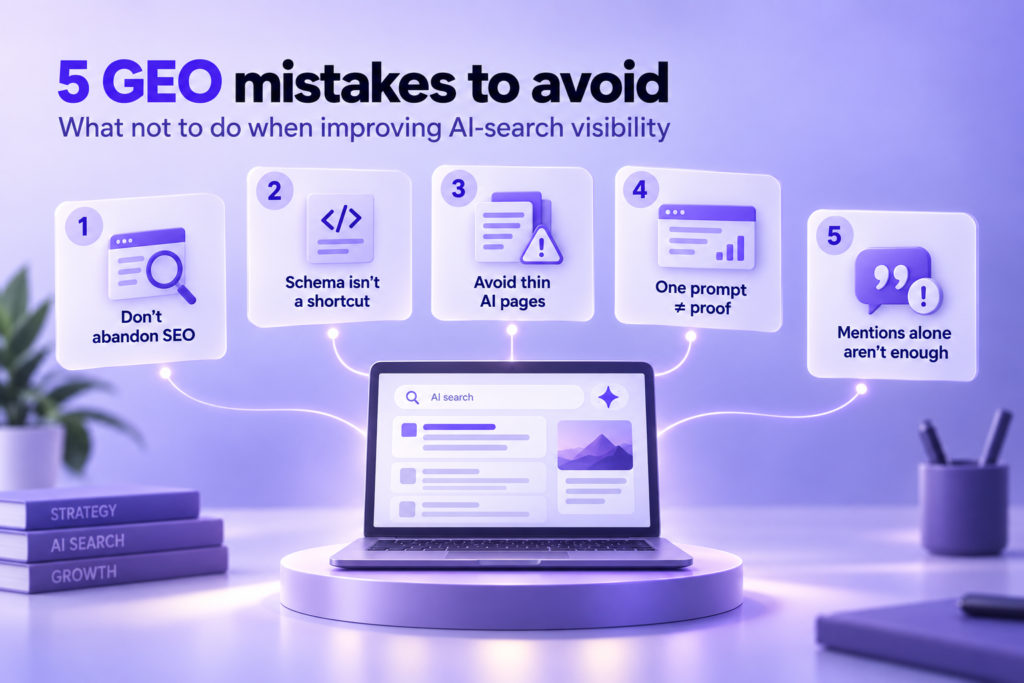
- The first is abandoning SEO because “AI is the future.” AI search still relies heavily on searchable, crawlable web content, and Google’s generative features are directly connected to its existing Search systems.
- The second is treating schema as a shortcut. Structured data is useful when it accurately represents visible information, but there is no special GEO schema that guarantees inclusion.
- The third is creating dozens of shallow FAQ or prompt-targeted pages. Google specifically warns against producing large numbers of pages for query variations simply to manipulate AI or search visibility.
- The fourth is measuring success with one prompt and one screenshot. AI results vary. Visibility needs to be assessed across a relevant set of questions and over repeated checks.
- The fifth is focusing only on whether the brand was mentioned. A company can be mentioned and still be described incorrectly, associated with the wrong service, or supported by an outdated source.
The quality of the mention matters.
When Should a Business Start Investing in GEO?
You do not need to wait until traditional search traffic declines.
GEO becomes especially relevant when your customers spend time researching and comparing providers, products, or solutions before making contact.
It is also worth investigating if your SEO already performs reasonably well, but your company rarely appears when AI tools are asked the commercial questions your customers ask.
Other warning signs include competitors appearing repeatedly while your brand is absent, AI tools misunderstanding what your company does, outdated information being surfaced, or your business having many services, locations or products that need to be represented consistently.
We are already seeing that demand directly at Digilite.
In September 2026, two separate inbound enquiries specifically requested AEO/GEO alongside SEO. They were not asking whether AI search might matter someday. They were already treating AI visibility as part of the search brief.
That is an important shift for marketing teams already investing in organic visibility.
How Digilite Approaches GEO
We do not treat GEO as a collection of tricks designed to “game AI Engines.”
Our approach starts by establishing what AI systems currently say about the business and where the brand appears across commercially relevant questions.
From there, we look at the wider search foundation: crawlability, technical SEO, the quality and clarity of important service or product pages, entity and business information, structured data where appropriate, content gaps and the sources supporting the company’s authority.
We can then identify where existing SEO work needs to be strengthened and where AI-specific monitoring provides an additional layer of insight.
Digilite’s current GEO service includes AI brand visibility auditing, entity and authority assessment, optimization of key pages, AI-focused content improvements, structured data enhancements where appropriate, visibility tracking and citation or mention monitoring.
Importantly, this work does not sit in isolation.
Our traditional SEO work already covers the technical, content, and authority foundations that search engines need. Digilite’s SEO case studies show how those foundations can materially increase organic discoverability, including a legal-platform campaign that increased organic traffic by 432% while substantially expanding its keyword visibility. That is an SEO result, not a GEO result, but it demonstrates why strong search foundations should not be discarded simply because the search interface is changing.
The next step is making sure that visibility extends into the places where customers are now asking questions.
Make AI Visibility Part of Your Search Strategy
If your business already invests in SEO, much of the foundation for AI search may already be in place. GEO helps you understand where that visibility carries into AI-generated answers, where gaps remain, and how your brand is being represented.
Want to see how your business appears in AI answers? Talk to Digilite about an AI visibility audit.
Frequently Asked Questions (FAQs)
- What Is the Difference Between SEO and GEO?
SEO focuses on improving visibility in traditional search results. GEO focuses on how a business is discovered, understood, mentioned, and cited inside AI-generated answers. GEO does not replace SEO. It builds on the same technical, content, and authority foundations.
- Can Good SEO Help My Business Appear in AI Engines?
Yes, strong SEO can improve the foundation AI systems rely on. Crawlable pages, clear service information, useful content, and credible authority signals can all support AI visibility. However, ranking well on Google does not guarantee that your business will appear in every AI-generated answer.
- Does My Website Need Special Schema for AI Search?
No special AI-specific schema guarantees visibility. Structured data can help search engines understand information already present on your website, but it should support clear, accurate content rather than act as a shortcut.
- What Type of Content Helps Improve AI Visibility?
Content that clearly answers real customer questions and demonstrates genuine expertise is more useful than generic articles. This can include comparisons, implementation advice, case studies, technical explanations, decision criteria, original examples, and detailed service information.
- Do Third-party Mentions Matter for GEO?
They can. AI systems may use information from multiple sources when building an answer. Credible reviews, industry publications, directories, partner websites, and other third-party sources can help reinforce what your business does and how it is perceived.
- How Long Does GEO Take to Work?
There is no fixed timeline because GEO depends on your existing SEO foundation, website quality, authority, content gaps, and how quickly search and AI systems discover updated information. Businesses with a strong SEO foundation may be able to build on existing visibility, while others may need more technical and content work first.
- Should I Invest in GEO If I Already Have SEO?
If your customers are using ChatGPT, Perplexity, or Google AI to research providers, compare services, or make buying decisions, GEO is worth evaluating. The goal is not to replace your SEO strategy, but to make sure your existing search visibility also carries into AI-assisted discovery.
- What Does an AI Visibility Audit Look At?
An AI visibility audit can assess how your business appears across relevant buyer questions, which competitors and sources are being surfaced, how accurately your services are represented, and where website or content gaps may be limiting your visibility.