
AI is changing more than how marketers create content, run ads, or automate daily tasks. It is now changing how businesses understand where their website visitors come from.
With Google’s May 13, 2026 update, Google Analytics now includes a dedicated AI Assistant channel for traffic from tools like ChatGPT, Gemini, and Claude. This gives marketers a clearer way to measure AI-driven discovery, compare it with organic search or paid ads, and see whether these visitors actually engage or convert.
What Changed in Google Analytics?
Google Analytics now has a dedicated AI Assistant channel in Default Channel Group reports. This means marketers can identify when users are discovering and visiting a website through recognised AI assistants such as ChatGPT, Gemini, and Claude.
The update introduces three important changes to traffic source dimensions:
- Medium: A new ai-assistant value is automatically assigned when the referrer matches a recognised AI assistant.
- Channel Group: These visits are now grouped under the AI Assistant channel.
- Campaign: Traffic from these sources is identified with the campaign name (ai-assistant).
Before this update, AI assistant traffic was harder to separate. Some visits may have appeared as referral traffic, while others could have been grouped under direct traffic if the source was unclear. Now, marketers have a more specific way to measure how generative AI is influencing website visits.
Why This Matters for Marketers
This update confirms something many marketers have already noticed: discovery is no longer happening only through Google Search.
People are asking AI tools questions like:
- “Which local digital marketing firm is the best?”
- “How can I improve my website’s SEO?”
- “What company offers AI process and marketing automation?”
- “How do I show up in Google AI overview?”
- “What are the best AI-driven customer service tools for small businesses?”
When an AI assistant provides an answer, it may recommend a brand, mention a service, summarise a page, or link to a website. If a user clicks through, that traffic can now be tracked more clearly in Google Analytics.
This changes what marketers do because AI visibility can no longer be treated as a vague trend. It is becoming a measurable channel.
A Real Example: Fresh Burger Appearing in AI Search
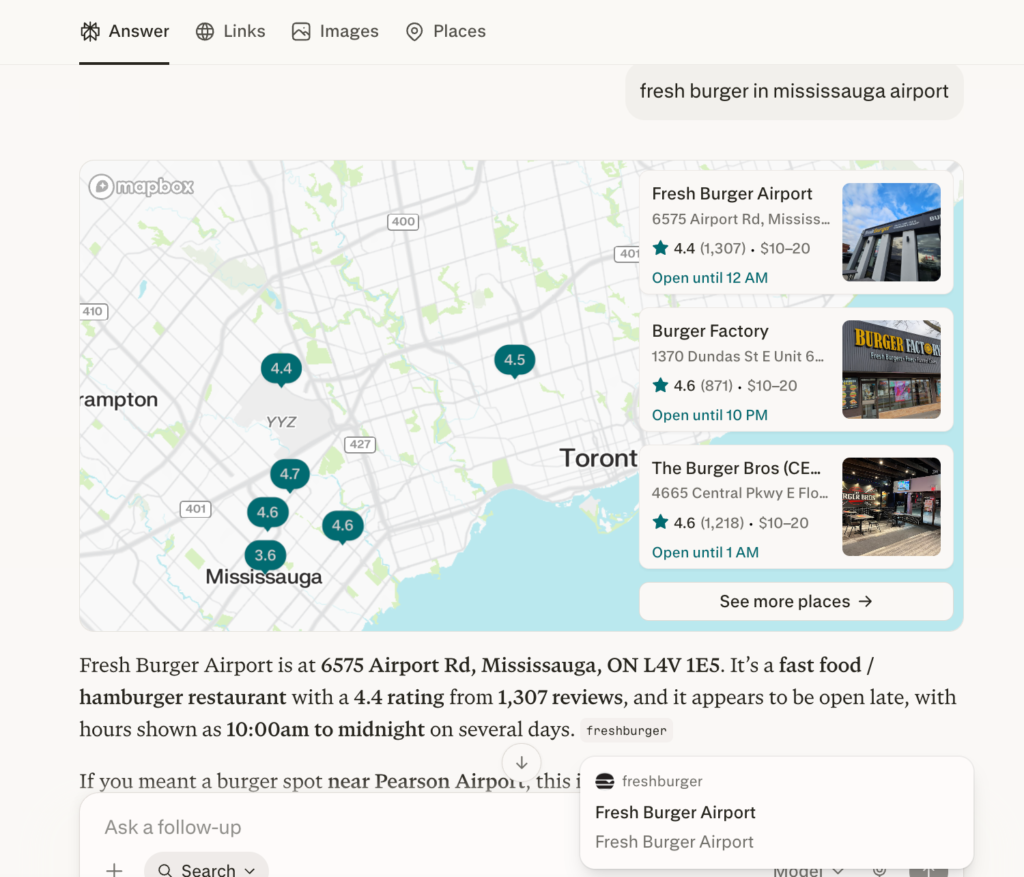
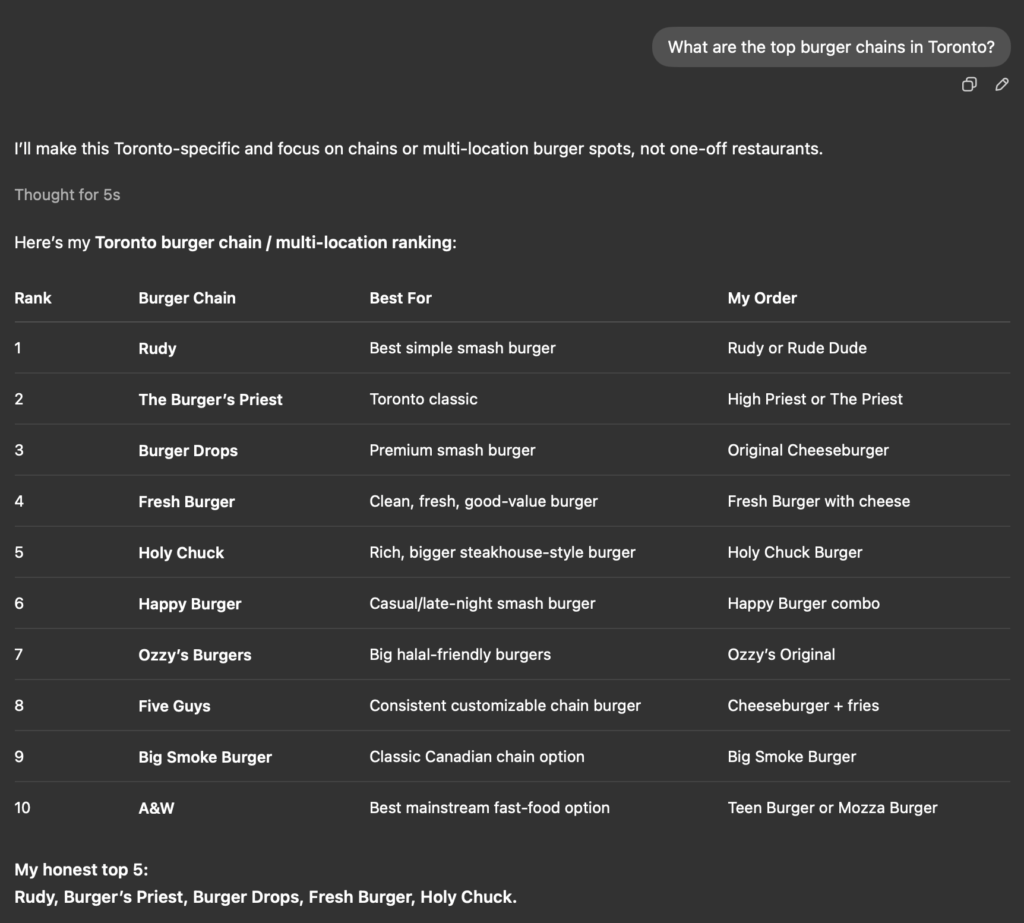
AI visibility is now a real marketing priority. One of our clients, Fresh Burger, is a strong example: after optimizing their content and local presence for AI-driven search, the brand now appears in AI results for relevant local queries, including burger searches in Toronto and near Mississauga Airport.
For marketers, the message is clear: ranking on Google is no longer enough. Brands also need to be understood, trusted, and recommended by AI platforms like ChatGPT, Gemini, Claude, and Perplexity.
This is where Generative Engine Optimization (GEO) comes in. At Digilite, we optimize content, brand authority, structured data, and digital presence so AI tools can better understand and recommend your business.
As shown in the screenshots, Fresh Burger is being recommended by AI tools, proving how AI-optimized SEO can help brands gain visibility beyond traditional Google results.
Perplexity
ChatGPT
Marketers Will Need to Rethink SEO Reporting
Traditional search engine optimization reporting usually focuses on keyword rankings, organic traffic, clicks, impressions, and conversions. These metrics still matter, but they do not tell the full story anymore.
With the new AI Assistant channel, marketers will need to add AI-driven traffic to their SEO reports. This means looking at questions like:
- Which pages are receiving traffic from AI assistants?
- Are blog posts, service pages, or FAQ pages being surfaced more often?
- Does AI Assistant traffic convert better or worse than organic search?
- Are users from AI tools spending time on the site or leaving quickly?
- Which topics seem to attract AI-driven clicks?
This will help marketers understand whether their content is useful not only for search engines, but also for AI-powered discovery.
Content Strategy Will Become More Answer-Focused
The rise of AI Assistant traffic will also change how marketers create content.
AI systems frequently search for knowledge that is understandable, useful, and organized. That means content should answer real customer questions directly. Long, vague pages filled with generic keywords may become less effective.
Marketers must instead concentrate on content that is:
- Clear and easy to understand
- Structured with strong headings
- Written around real customer questions
- Supported by useful examples
- Connected through smart internal linking
- Updated regularly
- Specific to the business, service, and audience
For example, a company offering digital marketing services should have strong pages and articles around SEO, PPC advertising, social media marketing, email marketing, branding, and AI-related services. The goal is to make the website easier for both people and AI systems to understand.
AI Visibility Will Become Part of the Marketing Funnel
Before this update, marketers could track traditional channels, but AI-driven discovery was harder to measure. Now, AI Assistant traffic can be reviewed as part of the full customer journey.
A user might first discover a brand through ChatGPT, return later through Google Search, click a remarketing ad, and then submit a form. Another may ask Gemini for service recommendations and visit a landing page directly from the AI answer.
This means marketers need to treat AI as an early touchpoint. AI traffic may start small, but it can bring highly intentional users who are already comparing options, looking for solutions, or ready to take action.
Landing Pages Will Need to Work Harder
If AI assistants are sending users to your website, your landing pages need to be ready.
A visitor coming from an AI tool may already have context. They might have read a summary, compared a few companies, or asked a very specific question before clicking. When they land on your website, they need to quickly understand:
- Who you are
- What you offer
- Why they should trust you
- What makes your service different
- What action they should take next
This is where AI web design becomes important. It is not only about adding AI features to a website. It is about creating smarter, clearer, and more helpful user journeys.
For example, a blog about AI-driven customer service tools should guide the reader toward a related service page. A page about AI integration into business should explain the process, benefits, use cases, and next steps. A page about how to show up in Google AI overview should connect naturally to SEO, content strategy, and technical website optimisation.
Paid Campaigns Will Need Better Attribution
The new AI Assistant traffic measurement will also affect paid marketing.
A user may first find a company through an AI assistant and later convert through a Google ad, Meta ad, or branded search campaign. Without reviewing AI traffic, marketers may give too much credit to the final paid click and miss the earlier AI-driven discovery stage.
This matters for PPC advertising because marketers need to understand how all channels work together. If AI Assistant traffic is introducing people to the brand, paid campaigns can help bring them back and move them closer to conversion.
Marketers may start creating remarketing audiences based on users who visit certain AI-related landing pages, read educational content, or engage with service pages after arriving from AI assistants.
Social and Email Marketing Will Also Be Affected
AI Assistant traffic may also influence social media marketing and email marketing strategies.
If marketers notice that certain topics are bringing AI-driven traffic, they can reuse those insights across social posts, newsletters, lead magnets, webinars, and campaign content.
For example, if a page about Agentic search or AI-powered SEO starts receiving AI Assistant visits, that may be a sign that the audience is interested in how AI is changing search behaviour. A marketing team could then create a LinkedIn carousel, email newsletter, webinar topic, or short video series around the same subject.
In this way, Google Analytics AI tools can help marketers identify which topics are gaining traction beyond traditional search.
What Marketers Should Do Next
This Google Analytics update should encourage marketers to adjust their reporting and strategy. A few practical next steps include:
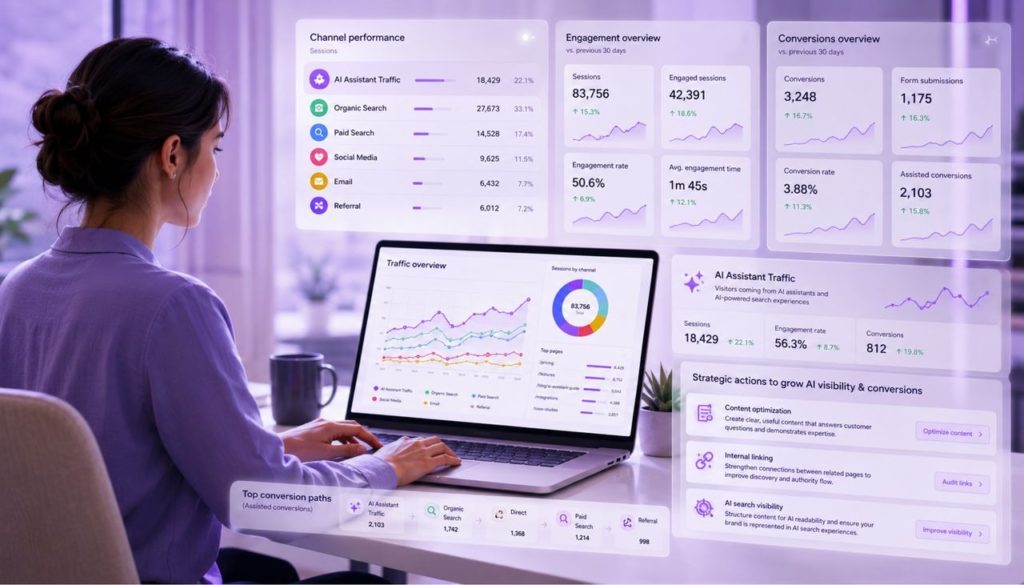
- Review the AI Assistant channel in GA4 Default Channel Group reports.
- Track which pages receive traffic from AI assistants.
- Compare AI Assistant traffic against organic search, paid search, social media, email, and referral traffic.
- Look at engagement rate, conversions, form submissions, and assisted conversions.
- Update important service pages with clear, helpful, and specific information.
- Create content that answers real customer questions.
- Strengthen internal linking between blogs, service pages, and conversion pages.
- Review whether your brand is visible in AI search experiences and Google AI Overview.
This update does not mean marketers should stop investing in SEO, paid ads, social media, or email. It means they need to add AI discovery to the bigger picture.
Ready to Measure and Win AI-Driven Traffic?
The May 13, 2026 Google Analytics update shows that AI-driven discovery is now part of everyday marketing measurement.
With the new ai-assistant medium, AI Assistant channel group, and (ai-assistant) campaign name, marketers can better understand how tools like ChatGPT, Gemini, Claude, and Perplexity influence website traffic.
AI is changing how people search, compare, and choose businesses. If people are asking AI for recommendations in your industry, your brand needs to be part of the answer. Book a Generative AI Optimization consultation today and start building visibility beyond traditional search.