

North America is a lucrative market for businesses aiming to expand, but success requires understanding subtle yet crucial differences between U.S. and Canadian audiences. While both countries share English as a primary language and similar cultural markers, consumer behaviour, spending habits, and online engagement differ significantly.
Let’s go over Canadian vs. American consumer behaviour.
Spending & The “De Minimis” Shift
In previous years, Americans consistently outspent Canadians per capita. In 2026, this gap has widened not just due to income, but due to logistics.
- The US Surge: US e-commerce is projected to hit $1.73 trillion this year.
- The Canadian Caution:
- Following the 2025 removal of certain de minimis trade exemptions, Canadian cross-border shopping slowed.
- In 2026, Canadians shifted from “caution to control,” prioritizing value-driven purchases and essentials like food and health.
- Strategic behaviours include:
- Stocking up on sales: 41%
- Switching to discount brands: 40%
- Despite growing online options, 83.5% of Canadian sales still occur in-store, as shoppers seek full control over basket costs.
- The Insight: Canadian consumers are increasingly intentional with spending, favouring savings and essentials over brand loyalty, while U.S. shoppers continue high-volume online purchases.
Social Commerce Trends in 2026: The Rise of “Shop-While-Scrolling”
Social shopping has exploded in 2026, with millions discovering and buying products directly through social platforms while browsing content. Globally, 5.2 billion people, about 64% of the world’s population, are active on social media, turning platforms like Facebook, Instagram, TikTok, and YouTube into major shopping hubs.
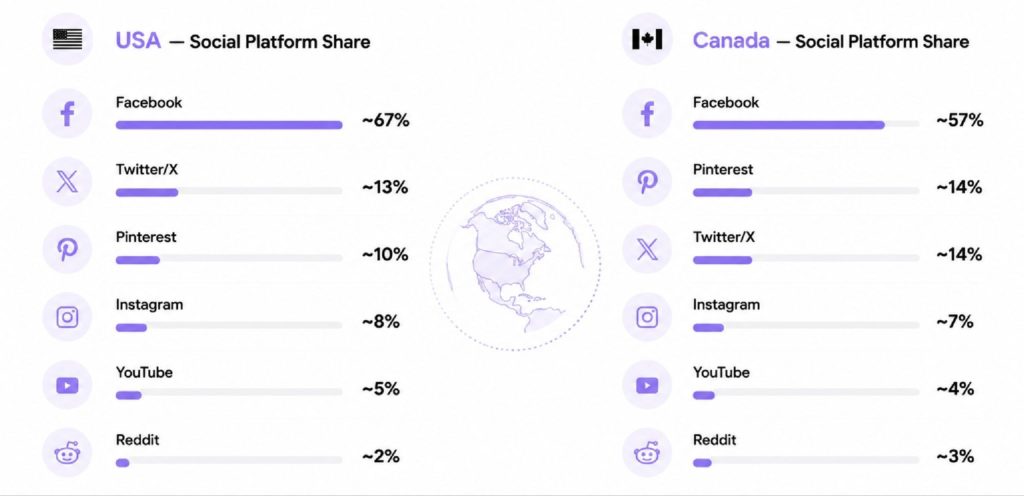
United States Social Commerce Insights
- The U.S. social commerce market is valued at $126.6 billion in 2026, projected to grow to $188.3 billion by 2030.
- Around 58% of U.S. social media users have purchased a product after seeing it online.
- Social commerce accounts for 8.9% of total U.S. e-commerce sales, expected to exceed 10% by 2027.
- Demographics:
- 25–34 years: largest group (23.1%)
- 35–44 years: 19.1%
- 18–24 years: 16.8%
- Seniors 65+: 9.6%
- Average spending: $650 per social buyer in 2026, expected to rise to $1,223 by 2027.
- Top platforms: Facebook remains #1 with 280M monthly interactions; TikTok Shop is rapidly growing with 80.4M U.S. users in 2026, expected to reach 91M by 2027.
Canada Social Commerce Insights
- Canada’s social commerce market is expected to reach US$86.36 billion in 2026, growing 8.9% annually.
- Platforms like TikTok, Instagram, and YouTube lead product discovery, often steering consumers toward purchases on merchant-owned channels.
- Social shopping in Canada is search-led, integrating AI tools, creator content, and influencer marketing to drive engagement and conversions.
- Regulatory and privacy compliance is shaping the landscape, emphasizing trust, transparency, and youth protections.
- Canadian shoppers increasingly embrace creator commerce, with brands like Sephora Canada and TikTok’s One Creator Marketplace establishing robust influencer programs.

Key Takeaway: Social platforms are no longer just engagement tools; they are full-fledged sales channels. Marketers targeting North American audiences must leverage platform-specific strategies, influencer partnerships, and seamless checkout experiences to maximize ROI.
The Digital Marketing Landscape: Canada Is Catching Up Fast
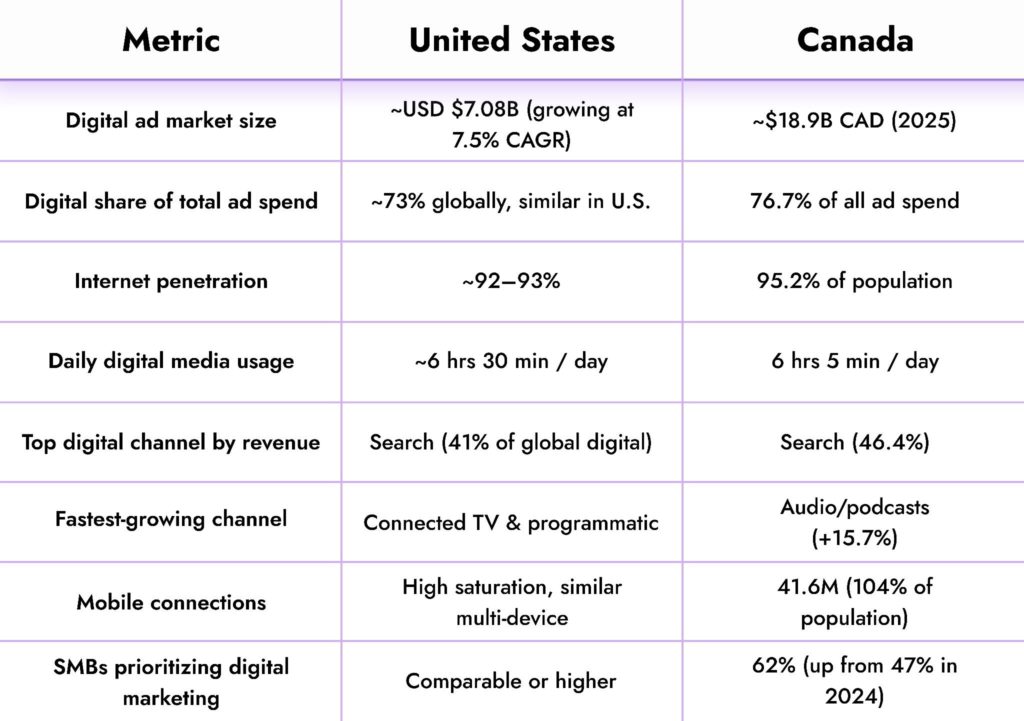
One standout difference: Canadian buyer journeys take longer. B2B buyers in Canada average 38 days from first touch to conversion (vs. shorter U.S. benchmarks), and B2C journeys run 11 days. Canadians research more, compare more, and take longer to commit, which directly affects how you sequence your marketing touchpoints.
📣 Marketing Implication
In Canada, retargeting campaigns, long-form content, and trust-building sequences matter more than in the U.S. Don’t expect the same conversion timelines; build nurture campaigns accordingly. Search advertising (SEO + SEM) remains the highest-ROI channel in both markets, but podcasts and audio are Canada’s fastest-growing opportunity right now.
Trust & Online Reviews: Canadians Are More Selective
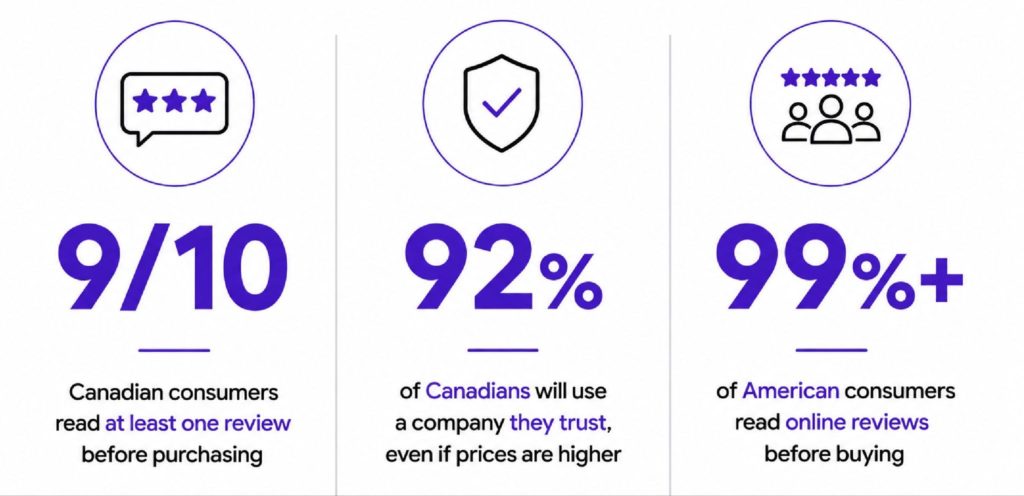
In the U.S., reviews are nearly universal in purchase decisions; 49% of American consumers place as much trust in online reviews as personal recommendations, rising to 91% among 18-34-year-olds. In Canada, 33% say they feel strongly influenced by online reviews, and 43% actually trust written reviews more than images or videos. Google dominates both markets; 63.6% of Canadians go to Google reviews first.
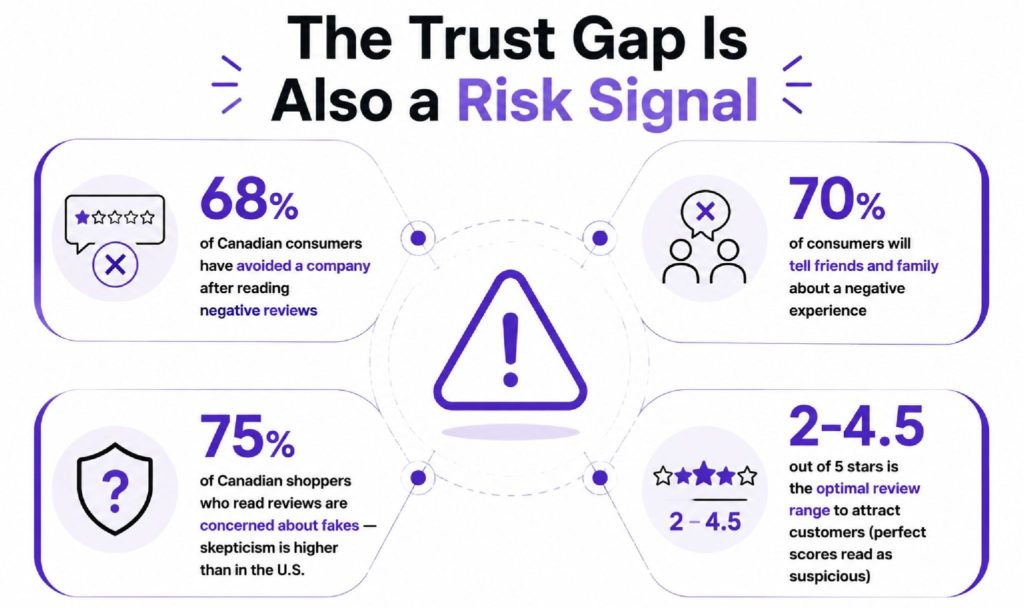
📣 Marketing Implication
In Canada, authenticity beats volume. Don’t chase 5-star perfection; a mix of genuine reviews (including handled negatives) builds more trust. Active review responses are especially important for Canadian audiences. In the U.S., volume and recency of reviews matter more.
Quick Reference: Canada vs. U.S. Marketing Snapshot (2025–2026)
Actionable Takeaways
- Tailor campaigns by market: Canadians respond to value-driven messaging; U.S. campaigns emphasize lifestyle and convenience.
- Localize your content: Toronto audiences prefer community-focused campaigns; LA audiences engage with aspirational, trend-forward storytelling.
- Balance online and offline strategies: Canadians still value brick-and-mortar experiences despite high internet use.
- Invest in creative visuals: LA’s competitive creative market shows higher market share for web designers and video production; video-first campaigns are key.
Example: Brands like Airbnb and Spotify target Canadian audiences with promotions and local events, while U.S. campaigns focus on aspirational lifestyle and visual storytelling.

![SEO in 2026: Preparing for AI-Driven Search and Zero-Click Results [Updated]](https://digilite.ca/wp-content/uploads/2025/04/AI-Driven-Search-and-Zero-Click-Results.jpg)