
![Brand Awareness vs. Brand Affinity: Meaning, Differences, Examples & Strategies [Updated 2026]](https://digilite.ca/wp-content/uploads/2020/09/Brand-awareness-vs-brand-affinity.jpg)
In 2026, being recognized is only the beginning.
A customer may know your name, remember your logo, or see your ads every week, but that does not automatically mean they trust you, choose you, or recommend you. That is the difference between brand awareness and brand affinity.
Brand awareness helps people recognize your business. Brand affinity makes them feel connected to it.
This distinction matters more now because customers are discovering brands across more places than before: Google, TikTok, Instagram, YouTube, reviews, creators, AI search results, newsletters, podcasts, and post-purchase experiences. Google has also expanded AI-powered search experiences, including AI Mode, which changes how people explore information and compare brands online.
So, the real question is no longer only: “Do people know us?”
It is also: “Do people trust us enough to choose us again?”
What Is Brand Awareness?
Generally speaking, brand awareness portrays the level to which your target audience is familiar with your brand and how well they recognize it. In other words, it is the extent to which customers are aware of the qualities or image of a particular brand.
“I am what I buy.” Branding and brand awareness are such a big part of our social, cultural, and even political life that it is a great factor in shaping our identity.
Have you ever witnessed a small fight between “Apple people” and “Samsung people,” heard of “Nike people,” or “Trader Joe’s” people? This is simply how deep brand awareness is rooted in our everyday life and, of course, decision-making processes. This is simply how brand awareness affects our lifestyles and purchase habits so that we don’t even think twice before buying a product of a certain brand.
Let’s take a more specific example.
It seems impossible to discuss branding and brand awareness without mentioning Apple at least once.
Let’s go back to 2006 when Apple introduced its new campaign “Get a Mac.” This campaign included a series of commercials featuring a young guy introducing himself with “Hi, I’m a Mac” and an older man with a blazer and glasses representing another computer brand.
The key concept of the campaign was to portray the idea that the computer you use also signifies what kind of person you are. Let’s be honest, who wouldn’t prefer to be a young and cool guy, like a Mac?
Hence, by buying a Mac, we identify ourselves with certain emotions, social status, and lifestyle. And that is all about how brand awareness psychologically affects our identity and decision-making.
Have you ever thought that the reasons we love a certain brand of sneakers probably have more to do with our brains than our feet?
But the role of brand awareness, especially in our current digital world, is probably more crucial than ever. So let’s dig deeper into why exactly brand awareness can be the foundation of your business.
Brand Awareness Example: Lenovo & Seedtag’s Neuro-Contextual Breakthrough
A recent prime example is Lenovo’s 2026 campaign run in partnership with Seedtag, a leader in Neuro-Contextual advertising. Built around Lenovo’s high-profile role as the official global technology partner of the FIFA World Cup 2026, the campaign aimed to solidify Lenovo’s positioning around AI and innovation among C-suite executives.
Instead of matching ads to standard keywords, Lenovo utilized Seedtag’s privacy-compliant AI, Liz, to identify the exact environments where senior decision-makers were most emotionally receptive. The results proved that emotional alignment amplifies brand awareness metrics exponentially:
- Excitement drove a +94% increase in top-of-mind awareness and a +27% boost in unaided awareness.
- Optimism unlocked 16 million incremental impressions by placing messages next to content focused on growth and confidence.
This proves that true brand awareness isn’t just about getting eyes on your logo; it’s about lodging your brand into the correct emotional context.
Brand Consideration vs. Brand Awareness
Brand awareness means people know you.
Brand consideration means people are seriously thinking about choosing you.
This difference matters because many brands stop at visibility. They run campaigns, get impressions, and assume the job is done. But if the audience does not understand your value, trust your proof, or see why you are relevant, they may never move from awareness to consideration.
A good awareness strategy should answer:
- Who are we?
- What do we do?
- Why should people care?
- Why should they trust us?
- Why should they choose us over another option?
That is how awareness becomes consideration.
Why Is Brand Awareness Important?
The common reasons why you should consider brand awareness are the following:
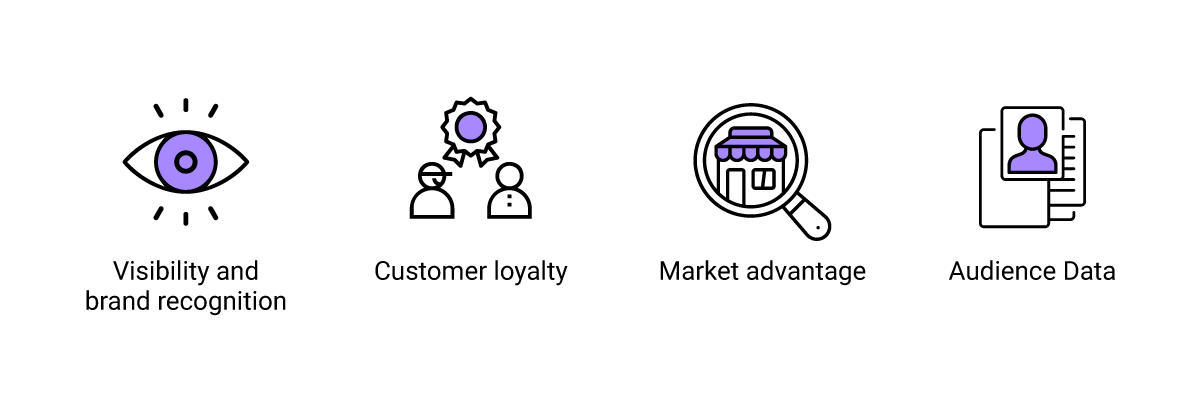
Visibility and Brand Recognition
Consumers face an overwhelming sea of choices daily. High visibility ensures your company is a natural “top of mind” option during the purchase lifecycle.
Customer Loyalty
When people recognize your brand and have positive experiences with it, they are more likely to come back. Brand awareness helps build familiarity, and familiarity often becomes trust, making customers more comfortable choosing you again.
Market Advantage
A recognizable brand has a stronger position in a crowded market. When customers already know your name, understand your value, and associate your brand with credibility, you have a better chance of being chosen over competitors.
Enriching Audience Data
Awareness campaigns generate crucial top-of-funnel datasets. Analyzing this traffic allows companies to build sophisticated audience segments, refine retargeting protocols, and personalize recommendations, which data shows influences up to 91% of modern buyers.
High-Impact Strategies to Improve Brand Awareness
1. Maintain Consistency, but Refresh the Experience
Consistency still matters, but modern brand awareness is not about repeating the same message forever. It is about keeping the brand recognizable while updating how people experience it. Coca-Cola’s 2025 return of “Share a Coke” is a good example. The campaign kept its familiar personalization idea but refreshed it with digital experiences, creator-led templates, and shareable content for a new generation.
2. Use Partnerships and Trusted Voices
Co-branded campaigns and influencers help brands reach audiences that already trust someone else. Nike and SKIMS introduced NikeSKIMS to combine Nike’s performance image with SKIMS’ body-focused positioning, helping both brands expand awareness in women’s activewear.
3. Focus on Emotional Context, Not Just Ad Placement
Modern awareness campaigns need to reach people in the right mindset, not just on the right website or platform. Lenovo’s 2026 campaign with Seedtag used neuro-contextual targeting to connect its AI and innovation message with moments where enterprise audiences were more emotionally receptive. The campaign reported a 94% lift in top-of-mind awareness and strong gains in message association.
4. Optimize for AI Search and Featured Snippets
Brand awareness now also depends on how clearly Google, AI Overviews, and AI search tools can understand your content. Google says optimizing for generative AI search is still part of SEO, so brands need helpful content, clear structure, accurate information, and strong technical foundations.
5. Create Content People Want to Save and Share
Awareness grows faster when content is useful or personal enough to travel beyond paid distribution. This is why campaigns like Spotify Wrapped continue to work well: they turn user behaviour into personal, shareable content. For other brands, this could mean interactive tools, checklists, quizzes, comparison guides, calculators, customer stories, or educational content that answers real search questions.
What Is Brand Affinity?
Brand affinity is the emotional connection people feel toward a brand because they relate to its values, personality, experience, or purpose.
It is not just about knowing the brand. It is about feeling that the brand “gets” them.
A customer with strong brand affinity may say things like:
- “I like what this brand stands for.”
- “This brand feels like me.”
- “I trust them.”
- “I would recommend them.”
- “I would still choose them even if another option is cheaper.”
That is the power of brand affinity. It moves the relationship from recognition to preference.
Brand Affinity Example: Samsung’s Post-Purchase Transformation
Many brands overspend on customer acquisition but drop the ball once the transaction concludes. Samsung Electronics America rewrote this multi-generational loop by proactively building brand affinity during the post-purchase experience.
Instead of waiting for things to break, Samsung deployed connected devices to diagnose appliance anomalies remotely, resolving minor issues (like an accidentally switched-off ice maker) before a technician was ever needed. This proactive service model boosted their diagnostic accuracy to 97% and their first-time fix rate to 85%.
By transforming customer care from a reactive “break-fix” center to a predictive experience that kept promises and offered ultimate visibility, Samsung converted a standard utility transaction into lifelong brand affinity.
Brand Affinity vs. Brand Loyalty
Brand loyalty and brand affinity are connected, but they are not the same.
- Brand loyalty means customers keep buying from you. This may happen because of convenience, price, habit, rewards, or product quality.
- Brand affinity means customers feel emotionally connected to your brand. They continue choosing you because they trust your values, identity, experience, and promise.
A customer can be loyal without affinity. For example, they may keep buying from a grocery store because it is close to home.
But when a customer has affinity, loyalty becomes much stronger. They are more likely to recommend the brand, defend it, engage with it, and stay even when competitors offer alternatives.
Brand Affinity vs. Brand Equity
- Brand equity is the overall value your brand adds to your business. It includes awareness, reputation, trust, perceived quality, loyalty, and market position.
- Brand affinity is one part of brand equity. It focuses specifically on the emotional relationship between your audience and your brand.
For example, Apple has strong brand equity because it is recognizable, trusted, highly valued, and commercially powerful. But it also has strong brand affinity because many customers connect with its identity around creativity, design, simplicity, and innovation.
In short: brand affinity helps build brand equity, but brand equity is the bigger business value created over time.
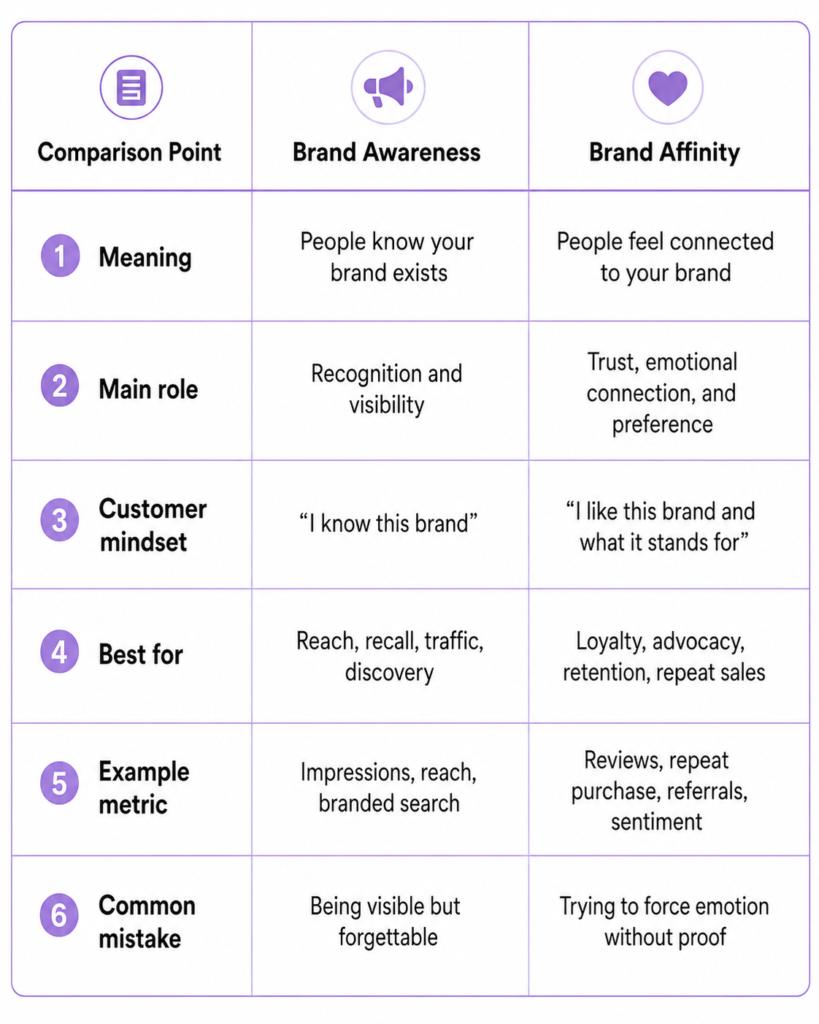
Brand Awareness vs. Brand Affinity
Why Is Brand Affinity Important?
Among the benefits and foundational importance of brand affinity, the following aspects should be considered:
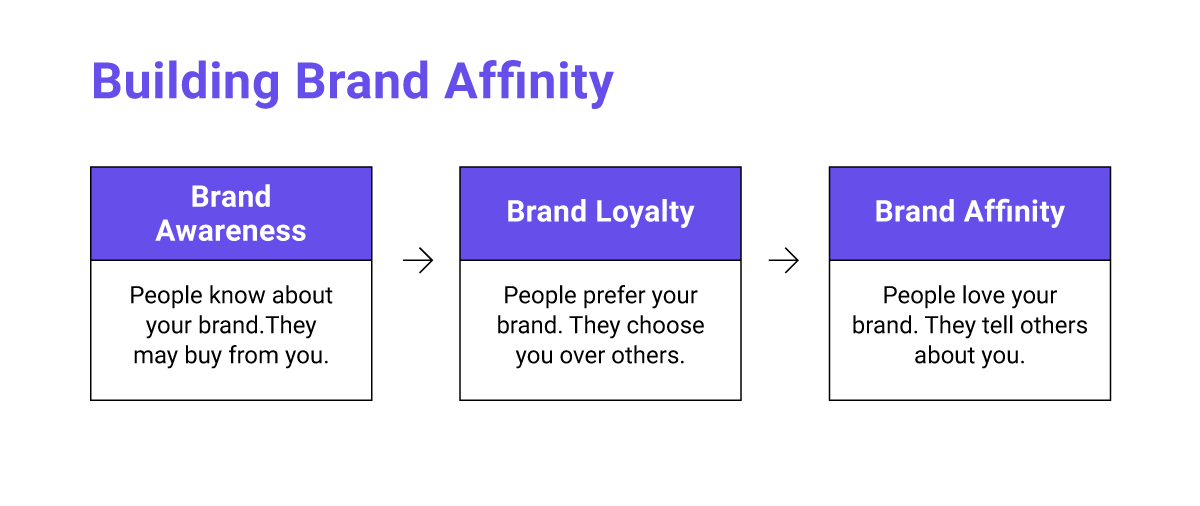
It supports stronger purchase decisions
By having a strong brand affinity, your customers become more invested in a sort of personal relationship with your brand. Let’s say if you stand for animal rights, or if you are vegan, or if you value companies that are attentive towards waste management and recycling, by being educated and aware that a certain brand has those values, you will potentially make a rationalized decision of choosing that brand over the others in the market. This will also result in a longer-term strong relationship with that brand and the shared values it stands for.
It makes competitors less convincing
If you own a business, you should be highly aware of the competitive threat. While it might be almost impossible to avoid competitors, especially for small or medium-sized businesses, you can still minimize their threats thanks to the power of brand affinity.
Let’s imagine that your favourite soft drink is Coca-Cola. Of course, there are various other less expensive, healthier, or even tastier alternatives in the market, but the treasured memories, feelings, and associations connected to the brand make your final decision of staying loyal to this brand and choose it over the others.
The thing is that regardless of the reasoning, when choosing this brand, you show brand affinity towards Coca-Cola that is unshakable.
It creates brand advocates
Being able to create a strong base of brand advocates should probably be one of the most valued benefits of brand affinity.
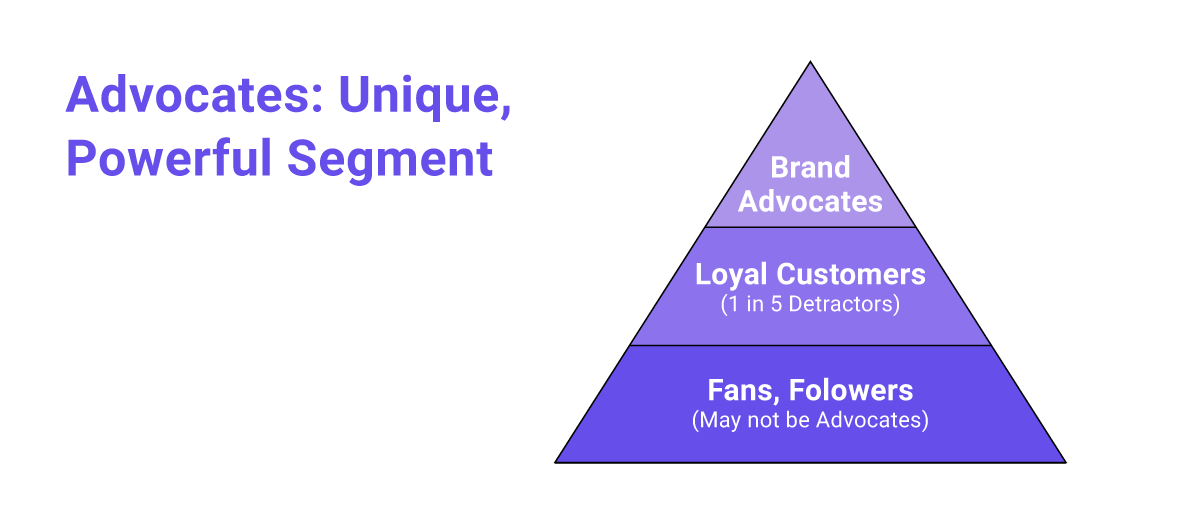
Brand advocates are considered one of the best, most effective, and trusted advertisements for your business. Brand advocates, or the people who highly value your brand, will do their best to let others know about your company, especially on social platforms and through word-of-mouth marketing. For example, Alaska Airlines ranked among the top national airlines in YouGov’s 2026 U.S. airline rankings, showing how positive customer perception can strengthen consideration and satisfaction over time.
High-Impact Strategies to Improve Brand Affinity
1. Leverage Data for Deep Personalization
Use CRM tools and predictive analytics to segment your audience based on behavioural patterns and localized trends, ensuring every communication feels uniquely tailor-made.
2. Prioritize Prevention Over Reaction
Shift customer success models from resolving issues to preventing them entirely. Transparent logistics, automated tracking, and proactive follow-ups forge deep operational trust.
3. Champion Your Unique Selling Proposition (USP)
Identify your true niche and lean heavily into it. Harley-Davidson doesn’t just market motorcycles; they sell ideas of freedom, community, and rugged independence. Align your brand with real-world principles your community actively cares about.
Both brand awareness and brand affinity are important and decisive factors for the growth of your business. Although their concepts might intersect often, they are also very different. Consequently, they have different methods, tools, and strategies to be increased and implemented.
Frequently Asked Questions (FAQs)
1. What is brand affinity?
Brand affinity is the emotional connection a customer has with a brand. It happens when people relate to a brand’s values, personality, experience, or purpose, not just its products or prices.
2. What is brand affinity in marketing?
In marketing, brand affinity is the strategy of building stronger emotional relationships with customers so they are more likely to trust, choose, recommend, and stay loyal to a brand.
3. What is the difference between brand awareness and brand affinity?
Brand awareness means people know your brand exists. Brand affinity means people feel connected to your brand and are more likely to choose it because they trust it or relate to it.
4. What is the difference between brand affinity and brand loyalty?
Brand loyalty means customers repeatedly buy from a brand. Brand affinity goes deeper because it is based on emotional connection, shared values, trust, and identity.
5. What is the difference between brand affinity and brand equity?
Brand affinity is the emotional connection people have with a brand. Brand equity is the overall value of the brand, including awareness, trust, reputation, loyalty, and market position.
6. What is the difference between brand consideration and brand awareness?
Brand awareness means people recognize your brand. Brand consideration means they are actively thinking about choosing your brand when they need a product or service.